
TL;DR: 5 Things To Know Before Comparing Pricing Models
- Interchange is not your bill. Visa’s Regulations and Fees for Small Business defines interchange reimbursement fees as transfers between acquiring and issuing banks. You pay a merchant discount to your provider, not interchange directly to a network.
- Flat-rate is predictable, not necessarily cheapest. The FCAC’s Overview of Card Payment Processing calls it blended pricing and confirms that blended plans vary by card brand, card type, and transaction type depending on your agreement.
- Interchange-plus separates card costs from provider charges, which makes statements more granular. Bank of America’s Credit Card Processing Fees guide states that the better structure depends on your common transaction types and volume.
- Your card mix drives more cost variation than your pricing model. Mastercard’s Merchant Interchange Rates list merchant category, authorization-to-clearing timing, enhanced data, and sales volume among interchange qualification criteria.
- Account-level charges sit entirely outside the transaction structure. Standard payment processing statements show separate sections for interchange, service charges, third-party activity, and account fees.
Understanding Your Payment Processor: Why Credit Card Processing Fees Are So Confusing
Every merchant who has ever compared two processing proposals side by side has run into the same problem: the numbers look comparable, the structures don’t, and nobody explains why.
A payment processor is a company that moves card transaction data between your business, the card networks, and your customers’ banks, then settles the money into your account. How that processor charges you for the work is where flat-rate and interchange-plus pricing part ways, and where many merchants end up guessing.
This guide explains both models in plain language. Not which one is “better,” because that question has no universal answer, but how each one behaves, what it hides, and what your own processing history needs to tell you before you can judge either.
At Digitech Payments, we’ve been doing this since 2011, which means 15 years of reading merchant statements across Canada and the US, in retail, e-commerce, service, and everything in between. The pattern we see most often isn’t merchants overpaying because they picked the wrong model. It’s merchants overpaying because nobody ever walked them through the statement line by line.
So let’s do that instead.
What Is Interchange, and Why Isn’t It the Same as Your Processing Cost?
Interchange is a transfer fee paid between financial institutions on every card transaction, not a fee you pay directly to Visa or Mastercard.
According to Visa’s Regulations and Fees for Small Business, interchange reimbursement fees move between acquiring banks and issuing banks for each transaction. Visa states plainly that merchants do not pay these fees directly. What you pay is a merchant discount negotiated with your financial institution or payment provider, and that discount bundles several processing services together.
This distinction matters more than it sounds. When a merchant tells us “my interchange is too high,” what they usually mean is “my total credit card processing fees are too high,” and those are different problems with different fixes. Interchange is a wholesale cost sitting underneath your pricing. Mastercard’s Merchant Interchange Rates define interchange as one component of the merchant discount rate established by the acquirer. One component. Not the whole thing.
The rest of your cost comes from somewhere. The FCAC’s Overview of Card Payment Processing distinguishes among three distinct fee buckets:
- Acquirer and processor fees: The direct charges applied by your merchant service provider for handling the transaction.
- Network-operator core fees: The underlying costs and assessments set by the card networks.
- Other charges: Additional costs tied to optional services or avoidable non-compliance penalties.
A headline transaction figure only speaks to part of one of these buckets.
Here’s the practical consequence. Two merchant service provider proposals can quote what looks like the same transaction cost while treating network fees, monthly account charges, gateway access, and compliance support completely differently.
One buries them, one itemizes them, and the merchant comparing only the big number in the pitch deck has no way to tell which is which. That’s not a pricing-model problem. That’s a disclosure problem, and it shows up in both flat-rate and interchange-plus arrangements.
Before you can evaluate any model, you need to accept a starting premise: interchange is a cost input, not a cost total. Everything else in this guide builds on that.
How Does a Card Payment Actually Move From Checkout to Your Bank Account?
A card payment moves through at least five parties, and understanding who does what is the foundation of evaluating any payment processor. The FCAC’s Overview of Card Payment Processing identifies the following participants in a typical transaction:
- The customer: The individual initiating the payment.
- The merchant: Your business accepting the transaction.
- The payment processor: The company moving the data and settling the funds.
- The card network: The brand infrastructure (like Visa or Mastercard) connecting the processor and the bank.
- The card issuer: The customer’s bank that approves or declines the funds.
In some three-party network arrangements, the processor and the issuer act as the same organization.
The transaction happens in two separate stages, and merchants routinely conflate them.
During authorization, transaction details travel from your payment processing products, like your physical terminal or e-commerce checkout page, through your processor and the card network to the issuing bank, which approves or declines. Nothing has moved yet.
Money moves during settlement, which happens afterward when transaction batches are submitted for funds movement.
Batching is where a lot of cash-flow confusion starts. The FCAC’s overview explains that transactions are usually grouped by your terminal, device, or platform alongside other transactions from the same business day, and then submitted to begin settlement.
If your batch cutoff falls before your busiest hours, your money moves a day later than you assumed. That’s an operational setting, not a pricing term, and most proposals never mention it.
Then there’s how the money arrives. The FCAC guidance notes that some processors deposit the full transaction amount and collect their charges later, while others deduct charges before funding you. Same total cost, completely different cash-flow experience. A business with tight weekly payroll feels that difference every Friday.
This is why we tell merchants that a credit card processing comparison built only on transaction pricing is incomplete by design. You’re not buying a rate. You’re buying authorization reliability, batch handling, settlement timing, funding presentation, and a phone number that gets answered when a deposit doesn’t land.
Knowing which party owns each piece of that chain tells you who to call when something breaks, and it tells you whether the company selling you the contract is actually the one accountable for the outcome.
How Does Flat-Rate Processing Work, and Who Does It Suit?
Flat-rate processing applies a consistent, predictable charge to card-payment transactions rather than varying the charge based on each transaction’s underlying characteristics. Canadian regulatory guidance uses the term blended pricing for the same idea. The FCAC’s Overview of Card Payment Processing states that under a flat or blended plan, a merchant pays a flat charge for card-payment transactions.
The appeal is real and shouldn’t be dismissed. Bank of America’s Credit Card Processing Fees guide defines flat-rate pricing as easy to understand and predictable because the price is fixed rather than shifting transaction by transaction. If you’re forecasting monthly costs for a board, a lender, or your own sanity, that stability has value that doesn’t show up in a cost spreadsheet.
Flat-rate is worth evaluating seriously when you prioritize straightforward forecasting, when you’re newer and don’t yet have enough reliable payment history to analyze card mix confidently, or when you simply don’t want statement-level variability from one transaction to the next. Those are legitimate business preferences, not naivety.
Two cautions, though:
- A flat presentation doesn’t guarantee a flat reality: The FCAC’s overview notes that a flat or blended plan also changes based on the payment-card brand, card type, and transaction type. “Flat” describes how the charge is presented, not a promise that every transaction is priced identically. Read the agreement, not the pitch.
- The flat transaction structure rarely covers everything: Transparent processor statements show account-level charges existing entirely separate from transaction charges, with examples such as monthly, statement, and minimum-related items.
If you evaluate a flat-rate offer, your core due diligence question is simple to ask and revealing to hear answered: what charges remain outside the flat transaction structure?
The main risk with flat-rate isn’t the model. It’s assuming the displayed transaction figure represents every cost you’ll incur.
That assumption is also exactly how teaser pricing works generally in this industry: a number that looks tidy at signing balloons once the account-level items, equipment terms, and optional services show up on statement three. Ask for the full picture up front, and flat-rate can be a sound, sensible choice.
How Does Interchange-Plus Pricing Work, and What Does It Really Show You?
Interchange-plus pricing separates the interchange cost set by the payment networks from the charges your merchant service provider imposes, then presents both.
Bank of America’s Credit Card Processing Fees guide defines the structure exactly that way: network-set interchange added to provider charges. The separated presentation makes it easier to see which portion of your cost is tied to the card ecosystem and which is tied to the provider relationship.
For merchants who want to audit their own costs, that visibility is the point. Well-structured interchange-plus statements feature distinct sections for interchange charges, service charges, and account fees, and note that total charges include processing services, software-related charges, and account-level charges.
When each category is broken out, a change in your costs has a traceable cause. You can tell whether your card mix shifted, a network cost moved, or your provider adjusted something.
Interchange-plus is worth evaluating when:
- You have enough statement history: You need baseline data to genuinely analyze your card mix, sales channel, transaction size, and volume.
- You have varied payment activity: The model suits businesses where the specific card type or acceptance method materially affects outcomes.
- You want detailed reporting: It requires merchants who are willing to read granular statements rather than relying on one summary line.
Now the honest part, because this is where a lot of content in this category oversells. Interchange-plus does not automatically cost less. A pricing structure is more itemized without being cheaper.
Bank of America’s guide states that the best pricing structure depends on your common transaction types and volume, and advises accounting for one-time, miscellaneous, and typical monthly charges. Itemization is a diagnostic tool, not a discount.
So the due diligence question for interchange-plus is different from flat-rate: which costs are passed through, which are provider charges, and how exactly are they shown on the statement? And the risk to avoid is assuming that transparency alone guarantees the lowest total cost.
Interchange-plus also puts more variability in front of you. Your monthly cost will move as your card mix moves. Some merchants find that informative. Others find it a distraction from running the business. Both reactions are valid, and the right answer depends on how you actually operate, not on which model sounds more sophisticated.
Why Do Card Mix and Transaction Channel Change the Answer?
Card mix and acceptance channel change your processing costs more than most merchants expect, which is why a single blended average tells you very little. The FCAC’s Overview of Card Payment Processing notes that under non-flat plans, charges vary based on the payment card brand, the card type such as premium or standard, and the transaction type.
Mastercard goes further on what actually drives qualification. Mastercard’s Merchant Interchange Rates list the following among qualification criteria:
- Merchant category: The specific industry classification code (MCC) assigned to your business.
- Time between authorization and clearing: How quickly your system submits transaction batches for settlement after the initial approval.
- Presence or absence of magnetic-stripe data: Whether the physical card was present and captured electronically (swiped, dipped, or tapped) versus manually keyed in.
- Enhanced transaction data: The amount of detailed line-item information (such as Level 2 or Level 3 data) passed along with the payment to the network.
- Merchant sales and transaction volume: The total dollar amount and the overall number of transactions your business processes.
Read that list again. Half of those are operational, not commercial. How fast you clear a batch and what data you pass with the transaction affects your cost, regardless of which pricing model is printed on your agreement.
Channel matters too, and it’s measurable. The Federal Reserve Board’s 2023 Interchange Fee Revenue report proves that card-not-present and card-present activity differ in average transaction value for U.S. debit and general-use prepaid transactions.
If you sell both in-store and online, blending those two streams into one average obscures the thing you most need to see. Pull them apart before you compare any proposal.
The Federal Reserve’s report also separates transaction and interchange data across non-prepaid debit, prepaid, covered, exempt, dual-message, and single-message categories. That granularity exists because these categories genuinely behave differently.
A merchant whose customers mostly tap debit has a different cost profile from one processing premium rewards credit on recurring subscriptions, even at identical monthly volume.
This is the practical reason two businesses with similar sales can receive very different credit card processing fees. Not favoritism, not luck. Different card mix, different channels, different transaction sizes, different qualification outcomes.
For merchants across multiple verticals in Canada and the US utilizing our diverse payment solutions, the takeaway is procedural. Before you evaluate flat-rate against interchange-plus, take these two steps:
- Separate your history by channel: Break out your activity into in-person, e-commerce, keyed, recurring, invoice, and mobile.
- Map your card details: Identify card brands, debit versus credit, and premium versus standard where your statement shows it.
That map is the input that makes a pricing comparison meaningful. Without it, you’re comparing marketing copy.
Does Average Ticket Size Change Which Model Makes Sense?
Yes. Average ticket size changes how per-transaction charges behave in practice, and ignoring it is one of the fastest ways to misjudge a proposal.
A percentage-style figure alone cannot tell you your effective cost, because a fixed per-transaction charge lands very differently on a small sale than a large one. The same charge that is trivial on a large invoice is significant on a low-ticket coffee sale, and no headline percentage reflects that.
Canada’s Code recognizes this by requiring both measures in merchant reporting. The FCAC’s Credit and Debit Card Code of Conduct mandates that transaction count and transaction volume appear, not just one or the other. Dollars and counts are separate signals, and a merchant needs both to understand their own cost structure.
Volume matters on two levels at once, which trips people up:
- Pricing model fit: Bank of America’s Credit Card Processing Fees guide states that volume shapes which pricing structure fits your common transaction types.
- Interchange rate qualification: Mastercard’s Merchant Interchange Rates lists volume among the criteria determining which underlying interchange rate applies to a transaction.
So volume influences both your negotiating position and the underlying cost of your transactions. That’s why we frame pricing as transparent and customized rather than published.
Terms get negotiated against your actual volume and transaction types, because those are the variables that determine what’s realistically available to you. A one-size-fits-all quote posted on a website can’t account for a business that runs high-ticket, low-count invoicing versus one running thousands of small taps a day. Any number quoted before someone reads your statements is a guess dressed as an offer.
Here’s a useful exercise: take your last few months of processing history and calculate, separately, your transaction count and your total sales for each channel. Look at where your counts cluster to determine what to scrutinize:
- High transaction count, small ticket size: Scrutinize per-transaction charges closely, as fixed cents-per-swipe fees consume a larger share of small sales.
- Low transaction count, large ticket size: Scrutinize percentage-based components and minimum-related account charges, as percentage points impact total costs far more than fixed per-transaction cents.
If you want that analysis done on your real numbers rather than a hypothetical, bring statements to your broker for a customized quote. That’s the only way ticket size gets factored honestly.
What Should You Actually Look For on a Payment-Processing Statement?
A payment-processing statement needs to let you separate card-network-related costs, provider service charges, and account-level charges, and if it doesn’t, that’s the finding.
A transparent statement demonstrates the structure worth expecting: distinct sections for interchange charges, service charges, and account fees, with total charges spanning processing services, software-related charges, and account-level charges.
Start with the account-level section, because it’s the one most merchants skip. These charges sit outside individual transactions entirely, with examples including monthly, statement, and minimum-related items. They don’t scale with your sales, which means in a slow month they represent a larger share of your total cost than your transaction charges do.
A proposal that quotes transaction pricing without disclosing this section is not complete.
Next, look for third-party activity. Clear processing statements include a separate third-party transaction section covering activity passed to outside service providers for processing and funding. That section answers a question worth asking directly: which services does this provider deliver themselves, and which are handed off? It changes who you call when something goes wrong.
Canadian merchants have disclosure standards to hold statements against. The FCAC’s Credit and Debit Card Code of Conduct requires statements to provide access to the following data:
- Effective merchant discount rate: The rate calculated for the aggregate of each accepted card type.
- Relevant rates and total amounts: The specific pricing tiers applied and the total dollars collected.
- Transaction counts and volume: The exact number of sales and the total dollar value processed.
For blended or flat-rate models specifically, the Code requires merchants to receive or have access to the per-transaction rate plus disclosure of other applicable charges not included in that rate.
Note that last phrase. Other applicable charges not included in that rate. The regulator assumes there will be charges outside the flat structure. So should you.
For U.S. merchants, these Canadian requirements don’t apply automatically, but they make an excellent benchmark. If a provider can supply that level of detail voluntarily, you learn something about how they operate. If they can’t, or won’t, you’ve learned something too.
Either way, ask for a line-by-line walkthrough with a human who can explain each section without reaching for a script. A provider who can’t read their own statement to you out loud is telling you what their support will feel like in six months.
How Do Funding Timing and Settlement Affect Your Cash Flow?
Funding timing is an operational risk, not a pricing detail, and it deserves its own conversation during any processor evaluation. Because settlement involves the processor, the payment network, and issuing banks, your deposits depend on a multi-party process, as the FCAC’s Overview of Card Payment Processing confirms. When one link in that chain stalls, your bank balance feels it before anyone explains why.
To protect your cash flow, there are three operational details you must cover during any processor evaluation:
- Ask about batching and cutoff procedures first. Since transactions are grouped by terminal, device, or platform during the business day and then submitted for settlement, your cutoff time directly determines which day a sale lands. A restaurant closing at midnight with an early evening cutoff is systematically a day behind on a meaningful share of its revenue. Nobody quotes that in a pricing proposal, but it shapes your working capital every single week.
- Ask how charges interact with funding. The FCAC’s overview notes that some processors provide the full transaction amount first and collect their charges later, while others deduct charges before funding. Neither approach is wrong, but they produce different reconciliation work for your bookkeeper and different daily deposit amounts in your ledger. Know which one you’re signing up for before month-end close forces the discovery.
- Ask about reserve practices and escalation procedures for delayed deposits. That second point is the important one, and it’s where service quality separates from sales quality. When a deposit doesn’t arrive on a Friday, you don’t need a pricing model. You need a named person who picks up, knows your account, and can trace the batch through the chain without asking you to re-explain your business from scratch.
This is the part of the relationship we consider non-negotiable. Being present when funding is delayed, when a dispute lands, or when something looks like fraud is what white-glove service means in practical terms. A support ticket queue that eventually replies is not the same thing as a proactive call telling you a batch didn’t settle and what’s being done about it.
When you evaluate a payment processor, write these funding questions down and ask them in the same meeting where you discuss pricing:
- Batching and cutoffs: What time does the daily batch close, and how does that impact which day my revenue lands?
- Deposit timing: How many business days does it take for cleared funds to reach my bank account?
- Deduction method: Are processing charges deducted daily before funding, or collected in one lump sum at month-end?
- Reserve practices (if relevant): Under what conditions are my funds held back, and for how long?
- Escalation path: Is there a named contact I can call directly to trace a missing batch?
The answers will tell you more about your next two years than the transaction structure will.
Why Does Chargeback and Dispute Support Belong in a Pricing Comparison?
Dispute support belongs in a pricing comparison because a single dispute reverses transaction value straight back through the payment chain, and no pricing model protects you from that.
Visa’s Dispute Resolution overview defines disputes as reversals of all or part of the transaction value by the issuer to the acquirer, and usually by the merchant bank to the merchant. The money leaves. Your pricing structure is irrelevant to whether you get it back.
What matters is speed and evidence. Visa’s overview advises that when an acquirer contacts a merchant about a dispute, the merchant’s best path toward resolution is a swift response. That single sentence needs to reshape how you evaluate providers.
Swift response requires four critical elements:
- Prompt notification: You are alerted immediately when a dispute is filed.
- Clear evidence guidance: You know exactly what documentation is required to fight the chargeback.
- Dispute condition clarity: Someone informs you which specific reason code or condition applies.
- Deadline management: Time-sensitive deadlines do not quietly pass inside an unmonitored inbox.
A provider who notifies you late effectively decides the outcome for you.
Prevention is the cheaper half of the equation. Visa’s Merchant Dispute Management Guidelines recommend that merchants clearly state return, refund, and cancellation policies at the time of the transaction, including on receipts where appropriate. That’s a low-cost operational change with a direct effect on dispute volume, and it applies whether you run a storefront or a checkout page.
Both channels need real procedures. Visa’s guidelines explicitly target card-present and card-absent merchants, covering prevention, responses, dispute conditions, compelling evidence, and staff training. Staff training is on that list for a reason. Your team is often the first to know a transaction looks wrong.
When you’re comparing a flat-rate proposal against an interchange-plus proposal, add these dispute questions to your evaluation list:
- Accountability: Who handles a dispute at your company?
- Notification process: How are you notified when a dispute is lodged?
- Evidence assembly: What evidence do they help you assemble and submit?
- Response timeline: What strict timeline applies to your submission?
- Human escalation: Is there a named human escalation path when issues arise?
A provider who answers those crisply is worth serious consideration. A provider who deflects to a knowledge base article is telling you what a bad week will look like.
This is where due diligence pays off in ways a spreadsheet won’t capture. Across 15 years and more than 1,000 reviews averaging a 4.4 out of 5 rating, the feedback that comes up most isn’t about structure. It’s about someone answering the phone when a dispute or a delayed deposit puts real money at risk.
What Do Fraud Prevention and PCI Obligations Have to Do With Choosing a Processor?
Fraud prevention and PCI compliance belong in a processor decision because your provider’s technology directly affects how much cardholder data your business touches. The PCI SSC’s Merchants: The Payment Process states that payment security is essential for every entity that stores, processes, or transmits cardholder data, and that PCI standards establish technical and operational requirements for organizations accepting or processing payments. That includes you, regardless of size or model.
You also can’t opt out of what applies to you. The PCI SSC’s “Do All PCI DSS Requirements Apply to Every System Component?” guide states that PCI DSS requirements apply to all system components unless a requirement is verified as inapplicable, and that organizations cannot choose which applicable requirements to implement based on their own perception of risk. “We’re too small for that to matter” is not a position the standard recognizes.
Here’s where it connects to your processor choice. The PCI SSC’s applicability guidance explains that whether particular requirements apply depends on a system’s function and its access to cardholder data, stored account data, cryptographic keys, or encryption and decryption mechanisms.
Meaning the architecture of your payment setup determines your compliance scope. A solution that keeps card data out of your systems produces a different obligation profile than one that routes it through your own environment.
That makes PCI scope a genuine comparison dimension, sitting right alongside cost. Make any prospective provider answer these questions directly and in writing:
- PCI scope reduction: How does your solution affect the cardholder data my business handles, and how exactly does your technology reduce my overall PCI scope?
- Fraud prevention tools: What monitoring tools come with the setup, and how does suspicious transaction activity get flagged and escalated day-to-day?
- Compliance support billing: Is compliance support included, or is it billed as an optional service? (This matters because optional-service charges show up on statements as account-level items and belong in your total-cost math.)
Recall that Canada’s Code distinguishes charges connected with optional services or avoidable non-compliance. Avoidable is the operative word.
Non-compliance charges are the kind of cost that never appears in a proposal and shows up later anyway, and a provider who proactively keeps you compliant is quietly saving you money that no pricing model accounts for.
Make any prospective provider answer this in writing: how does their technology reduce your PCI scope, and how does their fraud monitoring actually work day-to-day? A payment processor that treats scope reduction as core design work, rather than an upsell, is worth noting.
Flat-Rate vs. Interchange-Plus vs. Tiered: A Side-by-Side Comparison
Three pricing structures show up most often in merchant proposals across North America: flat-rate (also called blended), interchange-plus, and tiered. The table below compares them across the dimensions that actually determine your experience rather than the ones that make for a tidy sales slide.
Two things to keep in mind as you read it:
- None of these columns is a recommendation: The right structure depends on your transaction volume, average ticket, card mix, acceptance channels, business model, and how much statement detail you’re genuinely willing to review each month.
- The “core due-diligence question” row is the most useful line: Those are the questions that surface what a proposal leaves out, and they work on any provider in any market.
Tiered pricing gets its own column because merchants encounter it frequently and it behaves differently from either of the two models in this article’s title.
It groups multiple interchange outcomes into provider-defined tiers, which can look simpler than full interchange detail while being harder to independently verify.
The structure isn’t inherently unfair, but it demands more diligence on definitions and classification rules than either flat-rate or interchange-plus does.
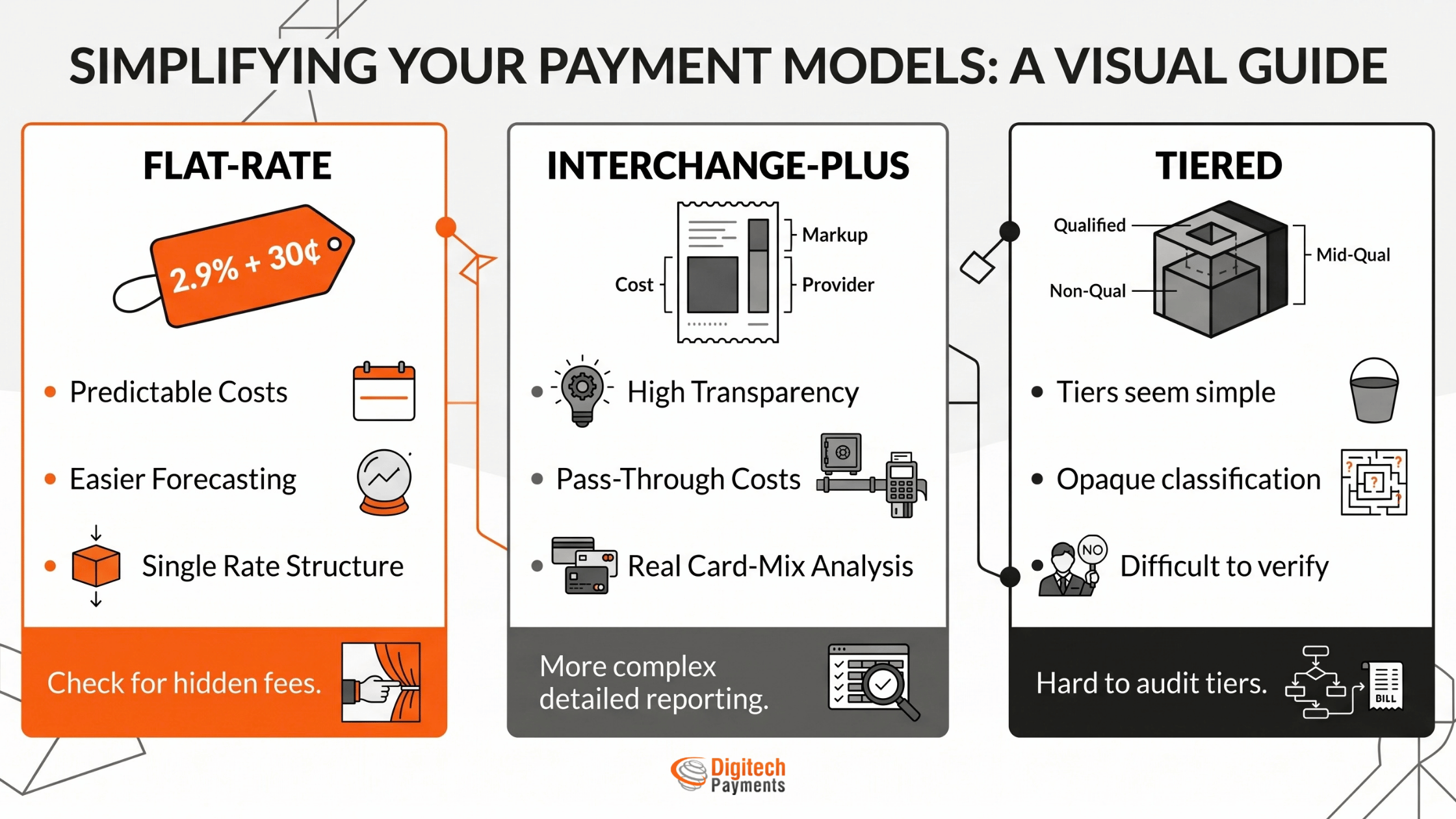
| Comparison dimension | Flat-rate / blended | Interchange-plus | Tiered |
|---|---|---|---|
| How charges are presented | A flat charge may apply to card-payment transactions | Interchange is separated from provider-related charges | Multiple interchange outcomes grouped into provider-defined tiers |
| Ease of forecasting | Generally simpler and more predictable at the transaction level | More variable, since transaction characteristics affect interchange | Looks simpler than full detail, but classification is harder to verify |
| Statement visibility | Check whether other charges are disclosed outside the flat charge | Allows granular review of interchange, service charges, and account fees | Ask how transactions qualify for each tier and how exceptions are handled |
| Merchant profile to evaluate | Simplicity and forecastability are high priorities | Enough transaction history exists to analyze real card mix and patterns | Requires close diligence on tier definitions and assignment rules |
| Core due-diligence question | What charges remain outside the flat transaction structure? | Which costs are passed through, which are provider charges, and how are they shown? | How does each transaction qualify for a tier, and can I audit that? |
| Risk of a shallow comparison | Assuming the displayed figure represents every cost | Assuming transparency alone guarantees the lowest total cost | Assuming few tiers makes the model easy to audit |
A 12-Step Checklist for Comparing Flat-Rate and Interchange-Plus Offers
- Gather recent statements and processing reports. Use a meaningful period of real history, not a single month and not promotional materials. Several months of actual data reveal seasonality, card-mix drift, and account-level charges that a one-month snapshot or a sales sheet fails to show you.
- Separate your sales channels. Break your history into in-person, e-commerce, keyed, recurring, invoice, and mobile activity. The Federal Reserve’s report proves card-not-present and card-present transactions differ in average value, so blending them into one average hides the variation that drives your actual cost.
- Document transaction volume and average ticket separately. Track both sales dollars and transaction counts. The FCAC’s Code of Conduct mandates both in merchant reporting for good reason: per-transaction charges and percentage-based charges land very differently depending on whether you run many small sales or few large ones.
- Map your full payment mix. Identify accepted card brands, debit versus credit, premium versus standard activity where your statement shows it, prepaid activity, and domestic versus cross-border transactions. The FCAC’s overview confirms charges vary by brand, card type, and transaction type under both flat and non-flat plans.
- Identify every party in your payment stack. Ask who the acquirer is, who the processor is, and who provides the gateway, terminal, and payment facilitation, if applicable. Add your funding contact. When a deposit stalls, knowing which party owns which link saves hours of being transferred.
- Request the complete commercial documentation. Get the merchant agreement, pricing schedule, equipment agreement, software agreement, cancellation procedure, renewal terms, funding policies, and dispute process. A proposal summary is marketing. The agreement governs you for the next several years.
- Ask for a line-by-line statement explanation. Have the provider distinguish card-network-related charges, provider service charges, account-level charges, optional services, and third-party activity. Industry best practices dictate these should be separate sections, so a provider who refuses to separate them is choosing not to.
- Compare total cost, not a headline figure. Include transaction charges, account-level charges, software, hardware, gateway, reporting, compliance support, and chargeback support. Bank of America’s guidance explicitly advises accounting for one-time, miscellaneous, and typical monthly charges before judging any structure.
- Ask how charges are deducted from your funding. Confirm whether charges come out before or after funds are deposited, and pin down the settlement schedule and batch cutoff times. The FCAC’s overview notes processors differ here, and the difference reshapes your daily cash position and your reconciliation work.
- Test dispute support before you need it. Ask who handles a dispute, how you’re notified, what evidence is required, what response timeline applies, and whether a named human escalation path exists. Visa’s overview advises that a swift merchant response is the best path toward resolution, and speed depends entirely on notification.
- Review fraud and security support in detail. Ask how the solution protects payment data, limits your PCI scope where possible, supports fraud prevention, and handles suspicious activity. The PCI SSC confirms scope depends on system function and data access, so architecture is a legitimate comparison point.
- Take everything to a broker for a customized quote. Hand over the actual statements and transaction history so pricing gets evaluated against your real card mix, volume, ticket size, channel mix, and operational needs. Any quote produced before someone reads your data is a guess, not an offer.
Once you’ve gathered your data and prepared your questions, bring them to the experts at Digitech Payments. We will review your statements and build a transparent, customized processing plan that actually fits your business.
Canada-Specific Transparency Rights Worth Knowing
Canadian merchants have disclosure and exit protections under the Code of Conduct for the Payment Card Industry that give them more leverage in a pricing comparison than many realize. The FCAC’s Overview of Card Payment Processing states that the Code’s purpose includes helping merchants understand card-acceptance costs, forecast monthly card-acceptance costs, encourage lower-cost payment choices, and choose which payment options to accept. That’s a transparency mandate written for your benefit, and it’s worth using.
Here are three specific protections worth knowing:
- Transparent quotes and rationale: The Code requires card-processing applications, quotes, and proposals to include a cost-per-transaction disclosure and disclosure of fees. It also requires that the data and rationale behind the quote, such as your card mix and volume, be provided so you can more easily compare proposals. That last requirement is the powerful one. It means you can ask a Canadian provider to show their assumptions, and if two proposals used different assumptions about your business, you can see it rather than guess at it.
- Notice and exit rights for post-signature changes: The Code also addresses changes after you sign. It requires advance notice within a defined window before certain new or increased charges are passed through, and it provides a no-penalty exit right tied to the effective date of a covered change. This directly counters the pattern of an attractive opening structure drifting upward once a merchant is locked in. You’re entitled to notice and, for covered changes, a door.
- Prohibition on negative-option acceptance: A provider cannot add a new payment-processing product or service without your express consent. If a service appeared on your statement that you never agreed to, that’s not a billing quirk in Canada. That’s a Code issue worth raising.
For merchants in the US, none of this applies automatically, and we’d caution against assuming otherwise without legal advice. But these requirements make a strong transparency benchmark you can apply voluntarily.
Ask a U.S. provider for the same disclosures a Canadian provider is obligated to give: cost per transaction, fee disclosure, and the card-mix and volume assumptions behind the quote. A provider comfortable with that request is showing you something useful. One who bristles is showing you something too.
The Bottom Line: Neither Model Wins on Its Own
Flat-rate pricing offers predictability and a simpler transaction-level presentation. Interchange-plus offers separation between card-related costs and provider charges, which supports a more granular review. Neither is universally cheaper, and any source telling you otherwise is skipping the part where your actual business gets examined.
What decides the answer is your own data: transaction volume, average ticket, card mix, and whether you sell in-person or online. Add contract terms, dispute support, and security posture, because those determine what a bad week costs you regardless of structure.
If you want a partner who builds transparent, customized pricing based on your real numbers, let’s talk. At Digitech Payments, we’ve been analyzing merchant statements since 2011, customizing plans by volume and transaction type so you never overpay. We’ll walk you through your statement line by line and design a pricing structure that fits your operational needs. Contact us today for a customized quote built on your actual card mix, channels, and ticket size.
Frequently Asked Questions
1. What is interchange, in plain terms?
Interchange is a transfer fee paid between financial institutions on card transactions, not a bill you receive from Visa or Mastercard directly. Visa states that merchants do not pay interchange reimbursement fees directly; instead, you negotiate and pay a merchant discount to your financial institution or payment provider, which bundles several processing services. Mastercard defines interchange as one component of the merchant discount rate established by the acquirer. So interchange is a cost input underneath your pricing, never the total you actually pay.
2. How to compare merchant service providers beyond price?
Compare statement clarity, funding practices, contract terms, renewal and cancellation procedures, security posture, fraud tools, chargeback support, technology fit, integration needs, and whether you get access to a knowledgeable human escalation path. Ask how charges are deducted from funding and when batches cut off, since the FCAC notes processors differ on both. Then ask for a line-by-line statement walkthrough. A provider who explains every section of their own statement demonstrates the service you receive after signing.
3. How to choose a merchant services provider in Canada?
Use the Code of Conduct for the Payment Card Industry as your framework. The FCAC’s Code requires quotes and proposals to include cost-per-transaction disclosure, fee disclosure, and the card-mix and volume data behind the quote, which makes proposals genuinely comparable. Confirm you receive statements showing the effective merchant discount rate by card type along with rates, amounts, transaction counts, and volume. Also verify notice rights for increased charges and the prohibition on adding services without your express consent.
4. What makes a good payment processing partner?
A good payment processing partner explains your statement line by line, tells you which services they deliver directly versus through third parties, and answers the phone during funding delays, disputes, and suspected fraud. They confirm batch cutoffs, deposit timing, and whether charges are deducted before or after funding. Visa’s overview advises that a swift merchant response is the best path to dispute resolution, and that is only possible if your provider notifies you fast with a named escalation contact.
5. How to vet a credit card processing company properly?
Request the full commercial documentation, not just the pricing summary: merchant agreement, pricing schedule, equipment and software agreements, cancellation procedure, renewal terms, funding policies, and dispute process. Ask how their solution affects your PCI scope, since the PCI SSC confirms requirements apply to all system components unless verified inapplicable. Then bring several months of real statements so pricing gets assessed against your actual card mix and volume rather than a generic assumption.
Works Cited
- Bank of America. Credit Card Processing Fees. Bank of America Business, 2025.
- Financial Consumer Agency of Canada (FCAC). Overview of Card Payment Processing. Government of Canada, 2025.
- Financial Consumer Agency of Canada (FCAC). Code of Conduct for the Payment Card Industry in Canada. Government of Canada, 2024.
- Federal Reserve Board. 2023 Interchange Fee Revenue, Covered Issuer Costs, and Covered Issuer and Merchant Fraud Losses Related to Debit Card Transactions. Board of Governors of the Federal Reserve System, 2023.
- Mastercard. Merchant Interchange Rates. Mastercard, n.d.
- PCI Security Standards Council (PCI SSC). Do All PCI DSS Requirements Apply to Every System Component?. PCI Security Standards Council, n.d.-a.
- PCI Security Standards Council (PCI SSC). Merchants: The Payment Process. PCI Security Standards Council, n.d.-b.
- Visa. Merchant Dispute Management Guidelines. Visa, 2024.
- Visa. Dispute Resolution. Visa, n.d.-a.
- Visa. Regulations and Fees for Small Business. Visa, n.d.-b.
