
TL;DR
- Visa’s 2026 Dispute Resolution Press Release reported processing 106 million disputes globally in 2025, a 35% increase since 2019, so rising chargeback dispute volume is an industry-wide operational reality, not a sign that a business is uniquely targeted.
- U.S. credit-card billing-error rules give consumers 60 calendar days after a charge appears on a statement to send written notice, while American Express’s US Disputes Reference Guide specifies cardmembers have up to 120 days from the transaction date.
- The same American Express guide states merchants have 20 days to respond, and Visa’s Dispute Resolution page advises swift response when your acquirer contacts you. Always use the case-specific reply-by date instead.
- According to the CFPB’s 12 CFR Part 1005.11: Procedures for Resolving Errors, financial institutions must adhere to a 10-business-day investigation timeline, extendable to 45 days with provisional credit, or up to 90 days for point-of-sale debit and specific transactions.
- Mastercard’s Chargeback Guide, Merchant Edition uses a 45-calendar-day second-presentment window from the chargeback settlement date, with pre-arbitration acceptance or rejection required within 30 calendar days.
Understanding The Chargeback Process And Dispute Timeline
A credit card chargeback is a reversal of all or part of a transaction’s value, pushed by the card issuer back through the acquirer and usually on to the merchant, according to Visa’s Dispute Resolution page.
That definition matters because it explains why there is no single answer to the question every merchant asks when a dispute notice lands: how long will this take?
The chargeback process involves a customer, an issuing bank, a card network, an acquirer or processor, and the merchant. Each one of those parties runs on its own clock. At Digitech Payments, we work with merchants across the United States and Canada, in storefronts and online, and the pattern is consistent. A customer may have weeks or months to raise a credit card chargeback.
Once the notice reaches the merchant, the window to respond is often measured in days. That imbalance is the single most expensive misunderstanding in dispute management.
This guide walks through the full chargeback dispute timeline stage by stage. We will cover:
- When a customer can file
- How issuers investigate
- What provisional credit really means
- How long merchants have to respond
- What happens when a case escalates
No rates, no fee talk, just the operational mechanics needed to run a tighter dispute process.
What Is A Chargeback, And Why Isn’t There One Clock?
A chargeback is a forced reversal of transaction value initiated by the cardholder’s issuing bank rather than by the merchant.
Unlike a refund, which the merchant controls, a chargeback moves money back through the payments chain whether or not the merchant agrees with the claim. Visa’s Dispute Resolution page describes it as a reversal of all or part of a transaction’s value by the issuer to the acquirer, and usually onward from the merchant bank to the merchant.
The reason there is no single average chargeback timeline is that four separate rule sets can touch the same transaction. Each framework has its own trigger, its own starting point, and its own outer limit:
- U.S. credit-card billing-error rules run from the statement date.
- U.S. debit and electronic-funds-transfer rules run from when the institution first sends the statement reflecting the error, and can extend for point-of-sale debit transactions.
- American Express runs its own dispute path with its own reply-by dates.
- Mastercard’s representment rules count from settlement dates.
That is why a merchant asking how long a chargeback takes is really asking four questions at once. The honest answer is a range of stages, not a guaranteed number of days.
The starting date shifts by dispute type too. A credit-card billing-error deadline runs from when the error appears on a statement, per the CFPB’s Credit Card Dispute guide. Certain Mastercard goods-or-services cases, by contrast, run from the latest anticipated delivery or performance date. Those are completely different anchors. A February sale with a June delivery date does not stop being disputable in April.
The practical consequence for a business is a records discipline, not a calendar rule. Retain the order date, authorization date, settlement date, shipment date, delivery date, cancellation date, and refund date for every transaction.
When a dispute arrives, the merchant will not know in advance which of those dates controls the case. Having all of them is the only way to respond confidently to the reason code actually received.
How Long After A Purchase Can A Customer File A Chargeback Dispute?
Longer than most merchants expect. Because timelines vary by network and payment type, a purchase made early in a billing cycle often carries dispute exposure well past the two-month mark from the actual transaction date.
Here is how the customer filing windows break down across the major frameworks:
- U.S. credit-card billing-error rules: Under this framework, a consumer must send written notice within 60 calendar days after the charge appeared on the statement, according to the CFPB’s Credit Card Dispute guide. This clock starts at the statement, not the sale.
- Debit and electronic-fund-transfer (EFT) errors: These follow a similar shape. The CFPB’s 12 CFR Part 1005.11: Procedures for Resolving Errors requires a financial institution to follow its error-resolution procedures when it receives qualifying notice no later than 60 days after sending the statement first reflecting the alleged error. Again, statement-based, not sale-based.
- American Express: This network extends further. American Express’s US Disputes Reference Guide states that cardmembers have up to 120 days from the transaction date to dispute a charge, subject to exceptions. Those exceptions include goods or services not received, returned or canceled goods and services, and redisputes, where the applicable timeframe varies.
- Mastercard and delayed fulfillment: Delayed fulfillment stretches the window the most. For some merchandise-or-services disputes, Mastercard’s Chargeback Guide, Merchant Edition permits the chargeback window to run within 120 calendar days of the latest anticipated delivery or performance date the merchant stated. For ongoing services that stop, the guide describes a window that runs from when the cardholder becomes aware the service ceased, subject to an outside limit in the guide.
One more wrinkle that’s worth knowing: paying a disputed charge does not prevent a consumer from disputing it.
The CFPB’s guide notes that reimbursement does not occur until the issuer decides in the consumer’s favor, but payment alone does not close the door. A settled invoice must not be treated as a closed risk.
Merchants who sell subscriptions, custom orders, pre-orders, event tickets, or anything with a gap between payment and delivery carry real exposure anchored to the promised delivery or performance date. That date should be documented clearly, along with any changes to it.
What Happens During The Issuer’s Investigation?
The issuer’s investigation is a customer-facing legal stage of the chargeback process that runs largely without merchant input, and its deadlines are not the merchant’s deadlines. Understanding this stage prevents a common mistake: assuming silence from a processor means the case died.
Here is how the investigation timelines differ based on the payment method:
- U.S. credit-card billing errors: The CFPB’s “Regulation Z” (12 CFR Part 1026.13: Billing Error Resolution) requires a creditor to mail or deliver acknowledgment of a qualifying billing-error notice within 30 days of receiving it. The rule then requires resolution within two complete billing cycles and no later than 90 days after notice. This is an issuer-side consumer-protection deadline, not a promise that the network dispute closes on the same schedule.
- Debit and electronic-fund-transfer (EFT) errors: The debit side moves faster at first. The CFPB’s 12 CFR Part 1005.11: Procedures for Resolving Errors gives a financial institution 10 business days to investigate. If the institution determines an error occurred, it must correct it within one business day of that determination and report results within three business days.
When 10 business days is not enough for a debit investigation, the rule allows an extension. The institution may generally take up to 45 days, but must provide provisional credit within 10 business days so the consumer has full use of those funds while the investigation continues.
Some disputes stretch further still. Up to 90 days can apply to transactions initiated outside a state, point-of-sale debit-card transactions, and transactions involving accounts within 30 days of the first deposit.
That 90-day debit window catches merchants off guard, because point-of-sale debit is exactly what a restaurant, salon, or retail counter processes all day. A card-present debit dispute from a busy Saturday can legitimately remain open for three months.
The takeaway from this section is a mindset shift. During the issuer investigation, the case is being built around the customer’s account, not the merchant account. The merchant’s moment arrives when the dispute is submitted through the network, and the acquirer sends a notification. Until then, the useful work is evidence retention, not waiting.
Does Provisional Credit Mean You’ve Already Lost The Chargeback?
No. Provisional credit is a temporary credit to the cardholder’s account while the issuer continues its investigation. It is a customer-account mechanic, not a verdict on the merchant’s evidence.
The CFPB’s 12 CFR Part 1005.11: Procedures for Resolving Errors permits an institution that cannot finish within the initial period to take up to 45 days, provided it issues provisional credit within 10 business days and gives the consumer full use of those funds.
Crucially, the same rule permits the institution to debit that provisional credit if it determines no error occurred, as long as it provides the required notice and protections around the debit. Temporary means temporary in both directions.
Merchants often conflate three different money movements during the chargeback process. They are separate events that happen on separate schedules:
- Provisional credit to the customer: A temporary deposit given to the cardholder while the issuer investigates the claim.
- A debit to the merchant account: The immediate removal of disputed funds from the business’s settlement balance.
- A final liability decision: The ultimate ruling that determines whether the merchant or the cardholder permanently retains the funds.
American Express’s US Disputes Reference Guide illustrates the point directly, as it explains that a dispute begins as an inquiry, where Amex requests information because it cannot resolve the matter from what it has, or as an upfront chargeback, where it debits the merchant account because it believes it already has enough information to proceed.
An upfront debit is not a final ruling. The same guide states that a sufficient and on-time response prevents a chargeback on the inquiry path, or reverses an upfront chargeback after supporting documents are supplied.
So yes, a merchant can win a chargeback after the account has already been debited. The money leaving settlement is a cash-flow event to reconcile, not a signal to stop working the case.
Where this gets expensive is when a business treats the debit as final, skips the response, and never learns whether the claim was legitimate. Two things happen immediately. First, recoverable revenue is forfeited. Second, critical diagnostic information is lost, meaning the merchant never discovers if the dispute came from a friendly fraud pattern, a descriptor problem, or a fulfillment breakdown.
Every case requires reconciliation against settlement reporting. This ensures the merchant knows with certainty whether funds were debited, whether a chargeback was reversed, or whether the matter remains open. Treating the debit as temporary and pushing forward with your evidence is a cornerstone of effective chargeback protection.
How Long Do Merchants Have To Respond To A Chargeback?
Use the reply-by date printed on the dispute notice. That case-specific date overrides every general number in this guide or anywhere else.
With that said, the published reference points give a sense of the compression. American Express’s US Disputes Reference Guide contains a dispute flowchart stating plainly that merchants have 20 days to respond.
Visa’s guidance to merchants is less numeric and more blunt: when the acquirer contacts a merchant about a dispute, swift response is the best path, according to Visa’s Dispute Resolution page.
The consequence of missing the date is not ambiguous. American Express’s Managing a Disputes Case page states that if a merchant cannot prove the validity of the charge by the reply-by date shown in its tool, a chargeback is issued to the merchant account. No extension, no second look at the merits.
Here is the part merchants underestimate. A processor or acquirer may impose an operational deadline earlier than the outer network timeframe, because they need time to package and transmit the response.
If the notice says 20 days and the processor needs the file by day 14, the real deadline is day 14. Merchants should ask their provider what the internal cutoff is before they ever receive a chargeback dispute, and keep it visible.
Now put the two clocks side by side to see the asymmetry of the chargeback process:
- The Customer Clock: A customer has 60 days from a statement date, up to 120 days from a transaction date, or 120 days from an anticipated delivery date to file a credit card chargeback.
- The Merchant Clock: A merchant has 20 days or fewer to build an evidence package answering a specific allegation about a sale that happened months ago.
That asymmetry is the entire argument for building an evidence retention system before it is needed to ensure comprehensive chargeback protection.
This is one of the places a merchant-services relationship earns its keep. Whether you operate a standard storefront or a complex e-commerce environment, having the right payment setup ensures you are prepared before a dispute ever hits.
In 15 years in merchant services, the pattern we see over and over is that the merchants who respond calmly are the ones whose records were already organized when the notice arrived. Backed by 1,000+ reviews and a 4.4 out of 5 rating, our experience shows that nobody assembles a clean packet from scratch in 72 hours during a busy week.
What Happens After The First Response In The Chargeback Process?
The first response is not always the end of the chargeback process. If the issuer accepts the evidence, the case closes. If it does not, network rules provide further stages, each with its own timeframe.
Here are the three main escalation stages following an initial response:
- Second presentment (Representment): Mastercard’s Chargeback Guide, Merchant Edition uses a 45-calendar-day timeframe for many dispute situations. The second presentment must settle on or before the 45th calendar day from the chargeback settlement date. During this stage, the acquirer re-presents the transaction with supporting evidence.
- Pre-arbitration: If the issuer still disagrees, pre-arbitration follows. This Mastercard guide describes pre-arbitration as a case-filing stage in which the acquirer accepts the case, takes no action, or rejects it with a rebuttal and relevant documentation. Acceptance or rejection must occur within 30 calendar days. Taking no action results in automatic acceptance; silence is a decision.
- Arbitration: Beyond that sits arbitration. The same Mastercard guide describes arbitration case filing as a further dispute-resolution stage, noting that in certain cases, pre-arbitration is optional and an issuer proceeds directly to arbitration.
Stack those stages and the arithmetic becomes clear. A chargeback dispute filed months after a sale, investigated by the issuer for weeks, responded to within 20 days, re-presented within 45 calendar days, and pushed into a pre-arbitration stage with a 30-calendar-day response period easily spans half a year from the original transaction to the final accounting entry.
Not every case travels that road. A credit card chargeback resolves quickly when the merchant accepts a valid claim or the issuer withdraws it. The long cases are the contested ones where evidence is challenged.
That is why the accept-or-fight decision at the start matters so much. Fighting a claim that cannot be supported with matching evidence buys months of administrative work for the same outcome.
To ensure comprehensive chargeback protection, keep the complete evidence packet, uploaded files, confirmation number, and internal notes from the first response. If the case escalates, those records are exactly what the acquirer works from, and reconstructing them later is far harder than storing them once.
What Documentation Do You Need To Fight A Chargeback And Win?
Evidence that directly answers the stated reason code. A generic packet of order confirmations and screenshots is the most common reason a well-founded response fails. Visa’s Merchants Dispute Management Guidelines set out different response approaches depending on why the transaction was disputed. For a late-presentment claim, the examples given include a transaction receipt proving the completion date, proof that a credit or reversal was processed, or a cardholder letter or email stating that the customer no longer disputes the transaction.
Notice how narrow and specific each of those is. A late-presentment case is about timing, so timing evidence wins it. Delivery proof does nothing there.
To ensure optimal chargeback protection, match your documentation directly to the allegation:
- Duplicate charge: Processing logs and settlement records showing a single authorization and single capture.
- Goods not received: Shipment confirmation, tracking, delivery confirmation, and any customer acknowledgment.
- Refund not received: The refund transaction record and the date it was issued.
- Unrecognized transaction: The descriptor submitted for clearing, plus any customer account or order history.
- Cancellation dispute: Proof the policy was disclosed and affirmatively accepted.
Format matters as much as substance. Mastercard’s Chargeback Guide, Merchant Edition requires supporting documentation in English or accompanied by an English translation. For Canadian merchants operating in French, and for cross-border sellers whose invoices or order systems generate records in another language, that is a real operational step to build into the workflow, not an afterthought at hour 19 of a 20-day window.
For a qualifying card-not-present credit card chargeback regarding fraud, Visa’s Compelling Evidence 3.0 Merchant Readiness document allows use of the customer’s own transaction history, as it states the framework requires a historical transaction footprint including two prior transactions meeting listed conditions. Those two historical transactions must be at least 120 days old and no older than 365 days, measured from the dispute date, with an exception noted for original credit transactions.
The data has to line up too. Visa’s criteria require at least two core data elements to match between the historical and disputed transactions, such as user ID, IP address, shipping address, or device ID and fingerprint.
Crucially, one matching element must be the IP address or the device ID and fingerprint. If an e-commerce platform is not capturing and retaining IP and device data at checkout, that entire evidence route is closed before a chargeback dispute is ever filed.
Should Merchants Fight Every Chargeback, Or Accept Some?
Accept some. Fighting every chargeback is not sound advice, and it is not how disciplined merchants operate. The right move is to compare the allegation against the evidence on hand, then either accept a valid dispute or submit a structured response that answers the stated reason.
Some claims are simply correct. Visa’s Merchants Dispute Management Guidelines point to circumstances where the merchant side is the problem: a transaction was duplicated, goods were not delivered, a refund was owed and not issued, or a policy was never properly disclosed.
Contesting those cases consumes staff time, delays the customer’s resolution, and produces the same outcome with more friction. Knowing how to handle a customer who disputes a charge sometimes means accepting you made a mistake.
Applying a simple, consistent triage rule separates the cases you can win from the ones you should accept. Ask these three questions in order:
- Does the allegation describe something that actually happened?
- Is there evidence that directly contradicts it, in a format the decision-maker can use?
- If the case escalates later in the chargeback process, will that evidence still hold up?
If any answer is no, accept and move on.
The discipline pays off twice. It concentrates effort on the cases that can actually be won, and it turns the dispute log into an operations report. When a pattern of valid disputes clusters around one product line, one shipping lane, one employee’s terminal, or one subscription renewal date, that is a process defect pointing to exactly where you need to improve your chargeback protection.
The same triage helps scale the response to the business model. A card-present retailer disputing a duplicate charge needs processing logs. A subscription business disputing a cancellation claim needs the acknowledgment record and the cancellation policy as it appeared at signup.
A card-not-present seller facing a fraud claim needs device and IP continuity. The PCI Security Standards Council’s Glossary identifies card present and card not present, including e-commerce and mail or telephone order, as distinct payment channels.
Different channels mean different evidence sets and different realistic win conditions. Because so many of our merchants run both in-person and online channels, the evidence question rarely has one answer per business.
Card-present, mobile, gateway, recurring-payment, and e-commerce setups each generate different records. Upgrading your point-of-sale or gateway can automate this data capture.
You can review the specific payment tools and hardware available on our products page to find the right fit for your channels. Getting the capture and retention right at setup is far cheaper than discovering a gap during a live dispute.
How To Handle A Customer Who Disputes A Charge Before It Becomes A Chargeback
The cheapest chargeback is the one that never gets filed. When a customer contacts a merchant confused or unhappy about a charge, there is a window to resolve it directly, and prevention work done upstream shrinks how often that call becomes a formal dispute.
Visa’s Post-Purchase Solutions for Merchants page describes pre-dispute information sharing as a way to clear up confusion before it becomes a chargeback, noting that Order Insight supplies transaction details to issuers and customers at the point of inquiry so unfamiliar but legitimate charges get clarified early. Many disputes are not fraud at all. They are recognition failures.
Several prevention controls are worth auditing this quarter, all drawn from Visa’s Dispute Resolution page:
- Descriptor clarity. The name submitted for clearing and settlement should be the merchant name most prominently displayed and recognizable to the cardholder. If the legal entity differs from the storefront sign or the website brand, fix the descriptor.
- Duplicate handling. Entering the same transaction more than once, depositing both the merchant and bank receipt copies, or depositing the same transaction through more than one merchant bank can cause duplicate-transaction disputes. Train staff to verify status before retrying a declined or timed-out sale.
- Shipping before deposit. Do not deposit transactions until the related merchandise has shipped, because customers may dispute when the charge appears before the goods arrive.
- Delayed-delivery communication. Tell cardholders when delivery is delayed, give the revised delivery or service date, and seek acknowledgment after delivery or service completion.
- Prompt submission. Submit transactions to the acquirer or processor as soon as possible, ideally within 1-5 days of the transaction date, which also reduces late-presentment exposure.
Policy disclosure deserves its own note. Visa’s Merchants Dispute Management Guidelines recommend clearly disclosing return and cancellation policies near the signature line on receipts or on a transaction-linked contract.
For internet transactions, the website must communicate the refund policy and require cardholder acknowledgment through click-to-accept, a checkbox, or an electronic signature. Availability is not acknowledgment. A policy buried in a footer link is much weaker evidence than a timestamped checkbox tied to the order record.
Handle the direct conversation the same way as the dispute file: get the order number, confirm what the customer believes happened, check the record, and either correct it or explain it with specifics.
Why E-Commerce Payment-Page Security Belongs In A Chargeback Protection Plan
Chargeback protection is not only a documentation exercise. For card-not-present merchants, the integrity of the payment page itself affects both fraud exposure and the credibility of the evidence submitted later.
The PCI SSC’s New Information Supplement states that payment-page scripts must be authorized, checked for integrity, and monitored for tampering under PCI DSS v4.x guidance to prevent e-skimming.
Skimming scripts harvest account data at checkout from pages that look and function normally. The resulting fraudulent transactions generate card-absent fraud disputes across many merchants, and the compromised merchant’s own transaction data becomes unreliable as evidence.
A widespread assumption needs correcting here. Using a third party’s hosted or embedded checkout does not transfer all responsibility away from the merchant’s site.
The PCI SSC’s FAQ 1588 on Payment Page Scripts states that an e-commerce merchant using a third-party processor’s embedded payment page or iframe must take action. They must either use techniques to protect their own webpage from scripts targeting account data, or obtain confirmation from their PCI DSS-compliant payment processor that the implemented solution includes script protection.
Either the merchant does it, or confirms in writing that the provider does. Assuming is not an option. If you are unsure whether your current setup meets these rigorous standards, our comprehensive payment solutions include secure, compliant gateways designed to protect your data continuity.
Connect that back to evidence. Visa’s compelling-evidence criteria depend on data continuity, such as IP address and device ID or fingerprint matching between historical and disputed transactions. Knowing how to handle a customer who disputes a charge requires having clean, reliable data to present.
A checkout environment with unmanaged third-party scripts, inconsistent session handling, or gaps in data capture undermines exactly the continuity that framework requires. Security hygiene and evidence quality are the same project viewed from two angles.
The scale of the problem argues for treating this as ongoing work rather than a one-time setup task. Visa’s 2026 Dispute Resolution Press Release reported 106 million disputes processed globally in 2025, a 35% increase since 2019. That figure serves as a diagnostic for industry trends, showing the direction of travel across the market.
To safeguard your chargeback process, you must be proactive. Take these practical steps to secure your checkout:
- Inventory every script: Document every script currently running on the checkout page.
- Verify authorization: Know exactly who authorized each one.
- Monitor for tampering: Actively watch for unauthorized changes to the code.
- Get written confirmation: If relying on an embedded form, obtain your processor’s written confirmation of protection techniques.
- Confirm data retention: Ensure the platform retains IP and device data long enough to support a chargeback dispute or credit card chargeback filed months after the initial sale.
Four Dispute Timelines Merchants Must Not Confuse
Most confusion about chargeback duration comes from mixing up frameworks that look similar but govern different things:
- Regulation Z billing-error deadline: This is an issuer obligation to a consumer. It is not the merchant’s response deadline.
- Regulation E provisional-credit rule: This describes how a bank handles a customer’s account during an investigation. It says nothing about when a merchant account gets debited.
- American Express: Amex runs an end-to-end dispute process as both network and issuer, meaning its reply-by dates apply directly to merchants.
- Mastercard’s representment and escalation timeframes: These govern what happens after the first response, and are counted from settlement dates rather than statement dates.
The table below separates those four frameworks so the correct clock can be identified for any given case.
Read it as orientation rather than a rulebook. Network rules change; the United States and Canada have different legal frameworks; and case-specific documentation always provides a more precise timeframe than any general reference.
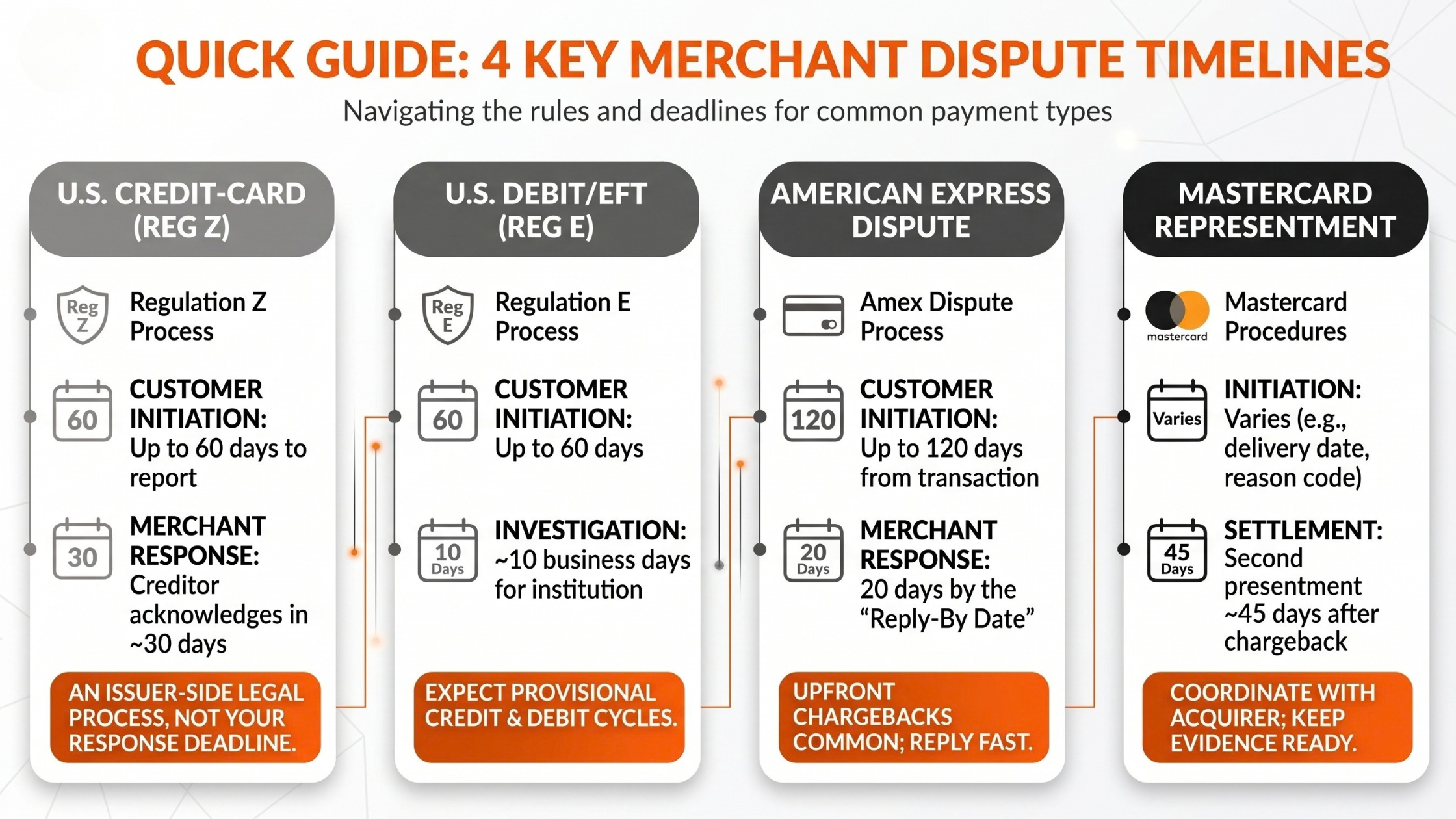
| Dimension | U.S. credit-card billing error | U.S. debit/EFT error | American Express merchant dispute | Mastercard representment/escalation |
|---|---|---|---|---|
| Primary framework | Regulation Z billing-error process | Regulation E error-resolution process | American Express dispute process | Mastercard network dispute procedures |
| Customer initiation reference | Written notice generally within 60 calendar days after the error appears on the statement | Qualifying notice generally within 60 days after the statement first reflecting the error | Cardmembers may have up to 120 days from transaction date, with exceptions | Varies by reason code; goods/services cases can depend on anticipated delivery or performance date |
| Investigation or response reference | Creditor generally acknowledges within 30 days | Institution generally investigates within 10 business days | Reference guide says merchant has 20 days to respond; use the case reply-by date | Second presentment settlement generally on or before the 45th calendar day from chargeback settlement |
| Provisional treatment | Do not assume a universal provisional-credit rule here | Institution may take longer if it provisionally credits the consumer under listed conditions | Amex may issue an upfront chargeback and debit the merchant account before documents are reviewed | Financial responsibility can move again during representment and escalation |
| How long it can stay open | Up to two complete billing cycles, no later than 90 days after qualifying notice | Up to 45 days generally, or up to 90 days in listed situations | Case documentation provides the exact timeframe | Can extend through second presentment, pre-arbitration, and potentially arbitration |
| What it means for you | An issuer-side legal process, not the response deadline | Expect provisional credit and longer investigation windows on debit | Review the reply-by date and requested documents immediately | Coordinate with the acquirer and keep evidence ready for later stages |
A 12-Step Checklist For Handling A New Chargeback
- Open the dispute notice the day it arrives. Locate the case number, transaction amount, transaction date, reason code, reply-by date, and the specific documentation requested. Never substitute a generic deadline read elsewhere for the date printed on the notice, because the case-specific date is the one that governs the outcome.
- Confirm the payment rail and the parties involved. Determine whether the case involves a credit card, a debit card, an American Express transaction, a Visa transaction, a Mastercard transaction, or another method. The applicable workflow, evidence expectations, and escalation path all depend on the rail and the acquiring relationship.
- Read the reason code before collecting a single document. A duplicate charge, an unrecognized transaction, a refund-not-received allegation, a goods-not-received claim, and a late-presentment dispute each require different records. Submitting one standard packet for every reason code is the fastest way to lose a case that should have been won.
- Preserve every relevant timestamp. Capture the authorization, transaction, settlement, order, shipment, delivery, cancellation, refund, and customer-contact dates. Different rule sets key off statement dates, settlement dates, or anticipated delivery and performance dates, and the controlling one is not known until the reason code is seen.
- Decide honestly whether the customer’s claim is valid. If the transaction was duplicated, goods were never delivered, a refund was owed, or the policy was not properly disclosed, accepting the dispute is usually the better business decision. Log it as a valid claim so the pattern shows up in monthly review.
- If the claim is invalid, assemble evidence that answers it directly. Depending on the case, that may include the receipt, order confirmation, customer acknowledgment, shipment and delivery confirmation, message history, refund records, proof of cancellation-policy acceptance, or qualifying historical transaction data under card-network criteria.
- Check that every document is legible, complete, and usable. Mastercard requires supporting documentation in English or accompanied by an English translation, which matters for Canadian merchants working in French and for cross-border sellers whose systems generate records in other languages. Build translation time into the internal deadline.
- Submit through the processor or acquirer ahead of the stated deadline. Visa directs merchants to work with their acquirer or processor on dispute practices, and American Express instructs merchants to respond by the reply-by date in its merchant tool. Ask the provider for their internal cutoff and treat that as the real due date.
- Save the submitted response and the confirmation. Keep the complete evidence packet, the uploaded files, the confirmation number, and internal notes in one place. If the case moves to representment or pre-arbitration, these records are what the acquirer will work from under a tight clock.
- Monitor for a decision, an information request, or an escalation. Some cases close after the first response. Contested matters can continue through second presentment, pre-arbitration, or arbitration, and each stage carries its own response period that someone on the team needs to own by name.
- Reconcile the case against settlement reporting. Confirm whether funds were debited, whether a chargeback was reversed, or whether the matter is still pending. Without that reconciliation, cash-flow visibility is lost, and accounting records drift away from what actually happened in the merchant account.
- Convert every dispute into a prevention fix. Ask whether the case points to an unclear descriptor, delayed fulfillment communication, weak refund-policy acknowledgment, duplicate transaction handling, payment-page security gaps, or missing evidence retention. One fixed root cause prevents many future disputes.
Bottom Line: Where A Merchant-Services Partner Fits In
Managing chargebacks isn’t just about fighting customer claims; it is a deadline-driven evidence project. Reversing a chargeback comes down to capturing the right timestamps, understanding the exact reason code, and submitting clean, precise documentation before the network’s clock runs out. The merchants who protect their revenue are the ones who build their evidence systems before the dispute ever lands.
That is where a proactive merchant-services partner changes the equation. Digitech Payments helps merchants across the U.S. and Canada navigate both card-present and e-commerce environments. Earning our reputation, with 15 years in business, 1,000+ reviews, and a 4.4 out of 5 rating, didn’t happen by competing on price; it happened by providing white-glove support when funding is delayed, when a complex dispute arrives, or when fraud is suspected.
If you want an expert to review your current dispute process, let’s talk. We help you navigate the system and stand by you when a dispute lands, ensuring you have the exact tools needed to manage them effectively. Contact us today to build a tighter, more profitable payments process. We’re ready to help.
Frequently Asked Questions
1. How long do I have to respond to a chargeback?
Use the reply-by date shown in the dispute notice or merchant portal, because that case-specific date governs the case. American Express’s merchant reference guide states that merchants have 20 days to respond, and Visa advises merchants to respond swiftly when the acquirer makes contact. A processor or acquirer may set an operational deadline earlier than the outer network timeframe so they have time to package and transmit the evidence. Confirm that internal cutoff with the provider before a dispute ever arrives.
2. How to fight a chargeback and win?
Winning comes down to answering the specific allegation with specific evidence, submitted before the deadline. Read the reason code first, then gather only the records that contradict that particular claim, such as timing proof for a late-presentment case or delivery confirmation for a goods-not-received case. A sufficient, on-time response can prevent a chargeback on an American Express inquiry or reverse an upfront chargeback after documents are supplied. Skip the cases where the customer is right and put effort where the evidence is strong.
3. What documentation do I need to fight a chargeback?
The documentation must match the dispute reason. Visa’s guidance for a late-presentment claim, for example, points to a transaction receipt proving the completion date, proof that a credit or reversal was processed, or a cardholder letter stating the customer no longer disputes the charge. For qualifying card-absent fraud disputes, Visa’s CE3.0 criteria call for two prior transactions generally at least 120 days old and no older than 365 days from the dispute date, with at least two matching data elements, one of which must be the IP address or device ID.
4. How to handle a customer who disputes a charge?
Resolve it directly before it becomes a formal chargeback whenever possible. Pull the order record, confirm what the customer believes happened, and either correct the error or explain the charge with specifics such as the date, items, and descriptor used. Visa describes pre-dispute information sharing, including Order Insight, as a way to clarify unfamiliar but legitimate charges at the point of inquiry. Many disputes are recognition failures rather than fraud, and a clear descriptor plus a quick answer often ends the matter.
5. What happens if my chargeback rate is too high?
Rising dispute activity is an operational signal worth taking seriously, and industry volume is climbing broadly. Visa reported processing 106 million disputes globally in 2025, a 35% increase since 2019, though that figure should not be used to predict any single merchant’s volume. Treat a climbing rate as a diagnostic: review descriptors, duplicate-transaction handling, fulfillment communication, refund-policy acknowledgment, and payment-page security. Talk to a merchant-services provider early, because patterns are much easier to correct before they compound.
Works Cited
- American Express. US Disputes Reference Guide. American Express, 2024.
- American Express. Managing a Disputes Case. American Express Merchant Support Center, n.d.
- Consumer Financial Protection Bureau (CFPB). How Do I Dispute a Charge on My Credit Card Bill?. Consumer Financial Protection Bureau, 2024.
- Consumer Financial Protection Bureau (CFPB). 12 CFR Part 1026.13: Billing Error Resolution. Consumer Financial Protection Bureau, n.d.-a.
- Consumer Financial Protection Bureau (CFPB). 12 CFR Part 1005.11: Procedures for Resolving Errors. Consumer Financial Protection Bureau, n.d.-b.
- Mastercard. Chargeback Guide, Merchant Edition. Mastercard, 2025.
- PCI Security Standards Council (PCI SSC). New Information Supplement: Payment Page Security and Preventing E-Skimming. PCI Security Standards Council Blog, 2025a.
- PCI Security Standards Council (PCI SSC). FAQ 1588: Payment Page Scripts. PCI Security Standards Council, 2025b.
- PCI Security Standards Council (PCI SSC). Glossary. PCI Security Standards Council, n.d.
- Visa. Visa Dispute Resolution Press Release. Visa Newsroom, 2026.
- Visa. Merchants Dispute Management Guidelines. Visa, 2024.
- Visa. Compelling Evidence 3.0 Merchant Readiness. Visa, 2023.
- Visa. Dispute Resolution. Visa, n.d.-a.
- Visa. Post-Purchase Solutions for Merchants. Visa, n.d.-b.
