

TL;DR
-
A merchant cannot block a cardholder from filing a dispute, but Visa’s Merchants’ Dispute Management Guidelines require the merchant to accept or reject the dispute after the processor forwards it, with the response routed back through the acquirer.
-
Visa’s dispute guidelines sort disputes into four categories: fraud, authorization, processing errors, and consumer disputes. Each category demands different evidence, so reading the reason code before gathering documents is step one.
-
Mastercard’s Chargeback Guide establishes a second presentment when goods were delivered as agreed, a refund had already been issued, or the chargeback was invalid, including disputes filed outside the applicable time frame.
-
American Express’s Manage Disputes page confirms that fewer than 0.030% of U.S. Card Member transactions in 2025 became disputes reaching merchants. That figure is network-specific and is not an industrywide chargeback rate.
-
Visa’s official documentation states plainly that compelling evidence does not require Visa, the issuer, or any party to conclude the cardholder participated in the transaction. Evidence improves a merchant’s position; it never guarantees the outcome.
What Is a Credit Card Chargeback and Can a Merchant Prevent One?
A chargeback is a card-network mechanism that lets a card issuer return a contested transaction to the merchant’s side of the payment chain after a cardholder disputes it and the issuer determines that a dispute right applies.
That definition, drawn from Visa’s Merchants’ Dispute Management Guidelines, matters because it answers the question most merchants ask first: no, a merchant cannot stop a customer from calling their bank and filing a credit card chargeback. That door is open to every cardholder.
What a merchant can do is respond. The chargeback process runs through several stages, and at more than one of them a merchant has a real, documented opportunity to present facts. The catch is that responding well requires preparation that must happen before the notification ever lands.
At Digitech Payments, we work with merchants across Canada and the United States, both in-store and online, and the pattern is consistent: the businesses that recover disputed revenue are those with organized records and a fast internal workflow. The ones that lose are usually the ones who found out too late what the deadline was.
This guide walks through the mechanics, evidence, and decisions so merchants know exactly what to expect when a chargeback dispute appears on their account.
Can a Merchant Refuse a Chargeback? Here Is the Direct Answer
A merchant cannot refuse a chargeback, meaning they cannot block it from happening. A cardholder contacts their issuing bank, the issuer decides whether a dispute right applies, and the process begins whether the merchant agrees or not. Visa’s Merchants’ Dispute Management Guidelines specify that the issuer makes the initial determination about whether a dispute situation exists.
What a merchant does is reject the dispute, which is a different thing entirely. The dispute lifecycle diagram in Visa’s dispute guidelines outlines the exact sequential flow:
-
The cardholder files a dispute with their bank.
-
The cardholder’s bank sends the dispute to the merchant’s card processor.
-
The processor forwards the notification to the merchant.
-
The merchant accepts or rejects the dispute.
Rejecting means submitting a timely, reason-specific response with supporting documentation to the acquirer or processor, which then presents the merchant’s position back to the issuer.
A merchant cannot block a customer from disputing a card payment, but can challenge an invalid dispute through its processor or acquiring bank. That distinction matters because it sets realistic expectations.
The merchant is not the judge. Visa’s administrative rules state that, administratively, the principal interaction in a dispute is between the issuer and the acquirer, and that the issuer sends the dispute to the acquirer, which may involve or completely bypass the merchant.
There is also a hard limit worth stating up front. Visa’s policy requires a merchant to respond to a dispute through its acquirer; if the merchant cannot resolve the dispute, the loss is borne by the merchant under the network process. That is the honest version.
Chargeback protection, in a practical sense, is not a shield that makes disputes disappear. It is a combination of prevention, documentation discipline, and knowing how to respond when a case is genuinely contestable.
What Happens Immediately After a Customer Disputes a Payment?
After a customer disputes a payment, the issuing bank forwards the disputed transaction to the acquirer, which then investigates it. If the dispute is valid, the acquirer deducts the disputed amount from the merchant account and informs the merchant. That sequence, established in Visa’s Merchants’ Dispute Management Guidelines, explains why so many business owners describe the experience as money vanishing before anyone asked them a question.
The debit is not the end of the story, though. It is a provisional financial position while the case moves through the formal chargeback process. The immediate next steps depend on the specific card brand:
-
Visa: According to Visa’s official documentation, the processor forwards the dispute to the merchant, who then accepts or rejects it.
-
Mastercard: Mastercard’s Chargeback Guide defines a second presentment as the acquirer’s response on the merchant’s behalf in eligible situations.
-
American Express: American Express’s Understanding the Disputes Process guide distinguishes an inquiry, in which the merchant provides documents or issues a credit before a chargeback is created, from an upfront chargeback, in which the merchant account is debited first, and the merchant submits documents to reverse the chargeback.
So the practical answer to whether the money is already lost is: maybe, and not necessarily yet. The first step is to determine which type of notification was received. A customer complaint is not a chargeback. An inquiry is not a chargeback. An upfront chargeback is, and the clock on it is already running.
One more thing to understand about timing. The Consumer Financial Protection Bureau’s How to Fix Mistakes in Your Credit Card Bill guide confirms that a U.S. card issuer has 30 days to acknowledge a billing-error notice and takes up to two billing cycles to complete its investigation. That is the consumer side of the timeline, and it helps explain why a dispute surfaces on a merchant account weeks after the sale.
Who Does What in the Chargeback Process?
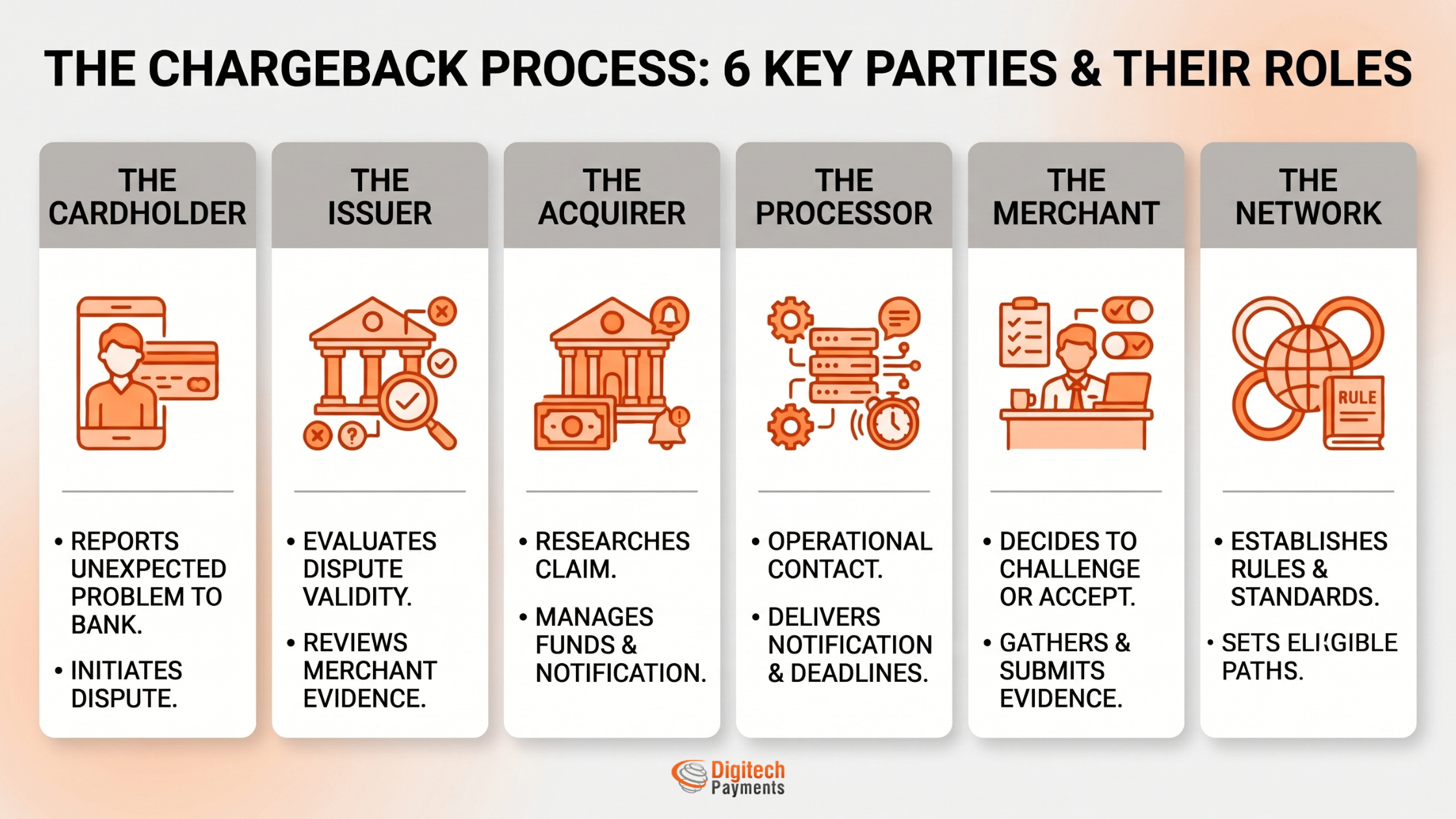
The chargeback process involves six parties, and each one holds a different piece of the decision. Understanding who controls what keeps merchants from directing their energy in the wrong direction.
-
The cardholder: Initiates the dispute. They contact their bank and describe the problem. Nothing a merchant does prevents this step.
-
The issuer: Acts as the cardholder’s bank. It determines whether a dispute situation exists and whether a dispute right applies. Visa’s Merchants’ Dispute Management Guidelines place this evaluation squarely with the issuer, both at the start and at the end. The issuer also evaluates the merchant’s evidence when it comes back through the chain.
-
The acquirer: Serves as the bank that holds the merchant account. According to Visa’s official documentation, the issuer sends the disputed transaction to the acquirer, the acquirer researches it, and if the dispute is valid, the acquirer deducts the amount and informs the merchant.
-
The processor: Functions as the merchant’s operational point of contact. It delivers the notification, states the response deadline, and explains how to submit. The practical implication of Visa’s structure is that a merchant responds through its processor or acquiring bank, rather than directly to the customer’s card issuer via a separate channel.
-
The merchant: Decides whether to accept or reject, gathers evidence, and submits on time. That is genuine control, but it is control over inputs, not outcomes.
-
The network: Sets the rules. Visa, Mastercard, and American Express each define categories, eligible response paths, and documentation standards. Mastercard’s Chargeback Guide limits what is considered late in the process: supporting documents submitted on or after a pre-arbitration or arbitration filing are excluded from its ruling.
There is one more document that matters more than most merchants realize. Visa’s dispute guidelines dictate that the merchant agreement defines the full extent of a merchant’s financial and administrative liability for disputes. A merchant’s own processing agreement governs account debits, reserve treatment, notification methods, and response procedures.
Merchants who have never read that section of their contract should read it. And if the language is unclear, that is exactly the kind of question a broker works through before a dispute ever arises. Finding the right processing structure tailored to your business model is crucial, and exploring customized payment solutions helps clarify these terms upfront.
What Can a Merchant Actually Control in a Chargeback Dispute?
A merchant controls exactly three variables in a chargeback dispute:
-
Whether to accept or respond to the chargeback.
-
Whether the response arrives before the provider’s deadline.
-
Whether the operating records are organized enough to support that response.
Everything else sits with other parties. Start with what a merchant does not control. A merchant does not control whether the customer files. A merchant does not control the issuer’s initial determination that a dispute right applies. And a merchant does not control the final evaluation, even with strong documentation.
Visa’s Merchants’ Dispute Management Guidelines state that compelling evidence does not require Visa, the issuer, or any other party to conclude that the cardholder participated in, received, or benefited from the transaction. Any service or workflow that promises a guaranteed win on chargebacks is overselling.
Now the part a merchant owns. Response timing is entirely within a merchant’s control. Miss the window the processor gives, and the case closes regardless of how good the files are.
Visa’s official documentation directs merchants to provide all available details and relevant documentation promptly upon initial dispute notification, because late evidence is completely dismissed under network procedure.
Record quality is a merchant’s responsibility too. Visa’s dispute rules mandate that evidence must be legible and in English, or accompanied by an English translation. A blurry photo of a delivery slip on a phone is technically a valid document, but it doesn’t help. Neither does a 60-page PDF dump with no explanation of what the reviewer is supposed to notice.
Mastercard’s Chargeback Guide requires the merchant’s explanation to address the claim in relevant situations, which shows that a short, direct narrative carries weight.
Finally, a merchant controls operational posture. Visa’s policy dictates that disputes result from merchant errors, but errors also occur with acquirers, issuers, and cardholders. That cuts both ways. Some disputes reflect a process failing. Some are genuinely invalid claims.
Quickly sorting one from the other is a discipline, and it is one of the areas where having a responsive processor relationship changes the results. When a funding delay, a fraud pattern, or a dispute spike hits, the difference between a provider who picks up the phone and one who does not is measured in recovered revenue.
Partnering with a dedicated processor like Digitech Payments ensures you have that responsive support in your corner.
When Should a Merchant Accept a Chargeback Instead of Fighting It?
A merchant accepts a credit card chargeback when the dispute is valid, when the transaction cannot be documented, or when the underlying issue cannot be remedied.
Visa’s Merchants’ Dispute Management Guidelines state explicitly that if the merchant cannot resolve the dispute, the loss is borne by the merchant. Fighting an accurate claim wastes staff hours and produces nothing.
The better question is how to tell the difference fast. Visa’s dispute guidelines provide four categories for initial sorting, and each asks a different factual question:
-
Fraud disputes: Require evidence linking the actual cardholder to the transaction.
-
Authorization disputes: Answered directly by transaction data proving proper approval.
-
Processing-error disputes: Require evidence showing the transaction was billed and submitted correctly.
-
Consumer disputes: Answered by refund records or fulfillment data (e.g., resolving a missing refund claim).
Mixing those categories up is the most common reason a response fails on merit.
Visa’s official documentation offers a clean example worth remembering. A claim for a missing refund requires evidence showing the amount and date on which the merchant submitted or processed the credit. If the credit was processed and the date is proven, there is a real case. If the credit was intended but never processed, there is not.
Mastercard’s Chargeback Guide defines specific situations where an acquirer triggers a second presentment: when goods or services were repaired, replaced, delivered, or provided as agreed; when a refund was previously issued; or when the chargeback itself was invalid. That third one gets overlooked.
Mastercard’s documentation outlines examples of invalid disputes, including those that:
-
Do not meet requirements.
-
Are filed outside the applicable time frame.
-
Duplicate an earlier chargeback for the same transaction.
-
Lack required documentation, or include illegible or incomplete documentation.
A procedurally defective dispute is contestable even when the customer’s underlying complaint possesses some merit.
Visa’s policy warns against treating every dispute as proof of wrongdoing or fraud. The reason code, transaction history, fulfillment facts, refund status, and customer communications together determine whether evidence answers the claim.
Running that five-point check before deciding is worthwhile. If four of the five support the merchant, respond. If they do not, accept the credit card chargeback, fix the operational cause, and move on. Staff time is worth more than a losing case.
What Documentation Supports a Merchant’s Chargeback Response?
The documentation that supports a chargeback response is whatever directly answers the specific allegation in the reason code. Visa’s Merchants’ Dispute Management Guidelines instruct merchants to provide all available details and relevant documentation promptly upon initial notification, and to ensure the material is legible and in English or translated into English.
For specific dispute types, Visa’s official documentation dictates the following documentation standards:
-
Merchandise or services not received: Respond with documentation showing that the cardholder or an authorized person received the merchandise or services as agreed.
-
Missed delivery date: Provide documentation supporting the expected delivery date.
-
Customer cancellation before delivery: Submit records verifying that the merchant was able to provide the goods or services and that the customer canceled early.
Mastercard’s Chargeback Guide details the merchant documentation that proves goods or services were delivered or provided as described, undamaged and not defective. It provides a specific, usable example: a signed cardholder acknowledgment that goods were received in good condition.
Two structural points shape how the package should be assembled.
-
First, submit early and submit complete. Mastercard’s documentation states that supporting documents submitted on or after a pre-arbitration or arbitration filing are excluded from its ruling. Evidence found later is simply never read.
-
Second, protect payment data while building the file. The PCI Security Standards Council’s data storage regulations forbid merchants from storing card verification codes or values after authorization, even encrypted. CVV, CVC, or CID data is never pulled into an evidence packet. The Council’s outsourced payment compliance framework establishes that merchants remain responsible for ensuring third-party payment providers protect account data appropriately, even when processing is outsourced.
There is a cost-benefit judgment here too. Visa’s dispute guidelines instruct merchants to weigh the value of the merchandise against the cost and benefit of obtaining proof of delivery or pickup, such as carrier certification that merchandise was delivered. Signature-required shipping on every low-value order is not a sound policy. On high-value orders, it often pays for itself the first time it is needed.
What Evidence Works for E-Commerce, Digital Goods, and Card-Not-Present Sales?
Card-not-present merchants need evidence that links a real person to a real delivery, and Visa’s Merchants’ Dispute Management Guidelines specify which types qualify. This is the hardest evidence category to build after the fact, which is why e-commerce operators establish it in advance.
Visa’s official documentation defines specific evidence requirements based on the transaction type:
-
Card-absent fraud disputes: Visa’s dispute rules validate photographic or email evidence that links the cardholder to the recipient or shows that the cardholder possesses or uses the merchandise or service. Customer service email threads that reference the product, loyalty account history, and prior undisputed orders from the same profile all reside in this territory.
-
Card-absent merchandise collected at a merchant location: Visa’s policy recognizes a cardholder signature on a pickup form, a copy of the identification presented, or identification details as acceptable evidence. Merchants running buy-online-pickup-in-store treat the pickup form as their single most valuable document, and it costs almost nothing to capture.
-
Card-absent delivery: Visa’s guidelines specify that evidence of delivery to the same physical address for which the merchant received an AVS “Y” or “M” match is acceptable, and explicitly state that a signature is not required for that evidence type. A clean AVS match paired with delivery confirmation to the matching address is a recognized evidence path without a signature.
-
Qualifying digital-goods transactions: The administrative documentation outlines successful download details, including a description of the goods or services and the download date and time, along with additional data such as the IP address, device geographic location, and device identifier. Software, media, and app businesses confirm that they log and retain these fields in their platform logs, because most do not by default.
Gathering this data efficiently is not a manual process. Utilizing the right payment processing products and integrations ensures your systems automatically capture and store these critical transaction details the moment a sale occurs.
Visa’s Compelling Evidence 3.0 Merchant Readiness guide defines the Compelling Evidence 3.0 framework, which helps merchants respond to certain card-not-present fraud disputes using structured, verifiable transaction data. Qualification does not guarantee a merchant win, and no provider sells it that way.
Effective chargeback protection requires proactive prevention alongside retroactive evidence. Visa’s Post-Purchase Solutions for Merchants page reports that exactly 62% of surveyed merchants experienced an increase in friendly fraud in a survey covering more than 1,000 merchants across North America, Europe, Asia-Pacific, and Latin America.
The same post-purchase resource also explains pre-dispute data-sharing tools that provide transaction details to issuers and customers at the point of inquiry, helping clarify unfamiliar charges before they become formal disputes. A recognizable billing descriptor does more chargeback protection work than most fraud tools.
How Do Refunds, Cancellations, and Return Policies Affect Chargebacks?
Refund and cancellation handling is one of the largest controllable sources of chargebacks, and Visa treats policy disclosure as a dispute-prevention requirement rather than a nice-to-have. In fact, transparent policies serve as your first line of chargeback protection.
Visa’s Merchants’ Dispute Management Guidelines state that clear return, refund, and cancellation disclosures help avoid misunderstandings and potential disputes, and that cardholders receive these disclosures at the time of purchase in both face-to-face and e-commerce environments.
The placement rules are specific. To prevent chargebacks, Visa’s official documentation requires merchants to disclose return and refund policies based on the specific transaction environment:
-
Front of physical receipts: Print the disclosure near the cardholder’s signature area or in a location easily seen by the customer.
-
Back of receipts or contracts: Require a dedicated signature or initials field if the policy appears on the back of a receipt or within a separate contract.
-
E-commerce websites: Present the policy clearly at the exact time of purchase. A policy buried three clicks deep in a website footer is not a valid disclosure.
Visa’s policy explicitly warns that failing to disclose these rules at the time of the transaction results in a dispute when a customer returns merchandise.
Recurring billing carries its own rules, and this is where subscription merchants get hurt. Visa’s dispute guidelines mandate strict cancellation protocols for recurring transactions:
-
The merchant must cancel immediately or as specified by the customer.
-
The merchant must confirm the cancellation in writing, including the effective date.
-
The merchant is prohibited from billing an account after a customer withdraws permission for the merchant to charge a Visa account.
-
The merchant must seek another payment method if a balance remains due.
Billing after a cancellation request is not a gray area open to argument.
On the evidence side, Mastercard’s Chargeback Guide establishes that recurring-transaction requirements include a description of the goods or services, the original transaction start date, and proof that the customer accepted recurring terms, such as click-to-accept records or a signed contract. Merchants whose signup flow does not store a timestamped acceptance record tied to the order build that before the next dispute arrives.
Refund timing matters too. Mastercard’s documentation specifies that when a refund was issued before a second presentment and properly and timely documented, the issuer closes the dispute for the refunded amount. Partial refunds leave the remaining disputed amount unresolved. A prompt, well-documented credit is often the cheapest resolution available, provided the merchant coordinates with its processor if a formal dispute is already open.
Why Do Cardholders Have Dispute Rights in the First Place?
Cardholders have dispute rights because both consumer-protection law and card-network rules create them, and understanding this legal layer explains why the chargeback process is structured to favor the customer’s initial claim.
In the United States, Regulation Z defines what counts as a billing error. The CFPB’s Billing Error Resolution regulation defines a billing error to include a credit card charge for goods or services that the consumer did not accept or that were not delivered as agreed. That category is broad on purpose. “Not delivered as agreed” covers:
-
Late shipments.
-
Substituted items.
-
Services that did not match what was promised.
There is a consumer-side clock. The Consumer Financial Protection Bureau’s credit card dispute guide requires U.S. consumers to send a written billing-error notice to the card issuer within exactly 60 calendar days after the charge appears on the statement to protect their rights under the Fair Credit Billing Act. For merchants, that explains the lag. A dispute arriving two months after a sale is normal, not suspicious.
Debit cards run on a separate track. The agency’s unauthorized transaction guidance requires a bank or credit union to investigate a reported unauthorized electronic transaction within 10 business days, with longer resolution timelines in certain circumstances. Debit-card and electronic-funds-transfer disputes follow a different U.S. framework than credit-card billing-error disputes, so the timelines and obligations merchants face vary by payment type.
For merchants operating in Canada, these U.S. rules do not transfer directly. Consumer dispute rights and bank investigation obligations vary by payment type, card network rules, and jurisdiction. This article is for educational purposes, not legal advice, and Canadian-specific questions should be directed to qualified counsel.
One volume note, carefully stated. American Express’s Manage Disputes page confirms that fewer than 0.030% of U.S. Card Member transactions in 2025 became disputes that reached merchants. That is network-specific data for one card brand in one country, and it does not represent an industrywide chargeback rate or a benchmark for any particular business.
Accept, Challenge, or Resolve: Comparing Your Three Options
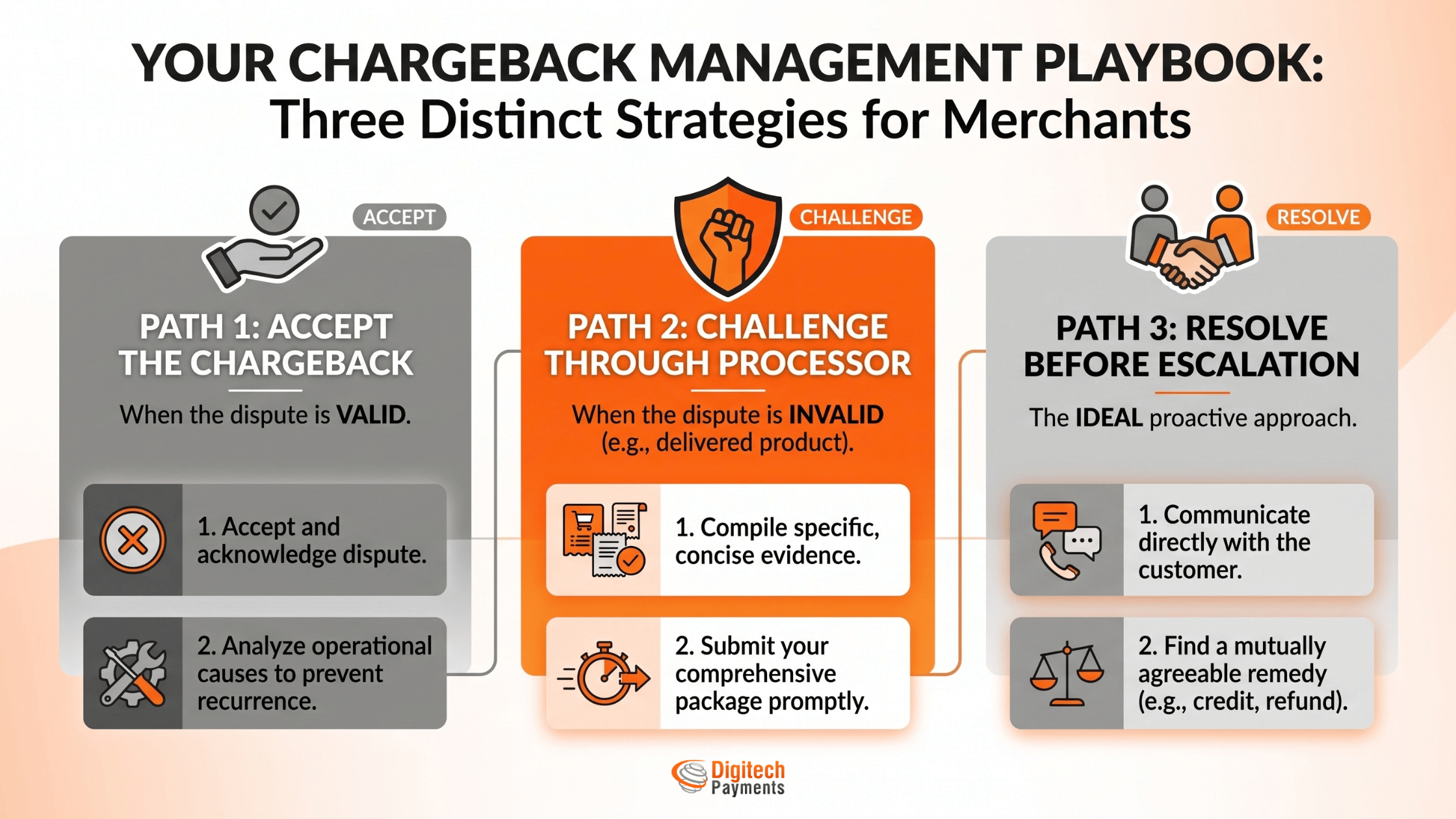
Every chargeback dispute falls into one of three lanes, and choosing the right one quickly protects both margin and staff hours. The three options are:
-
Accepting the chargeback.
-
Challenging it through a processor or acquirer.
-
Resolving the customer’s issue before it escalates into the formal network process.
The decision usually turns on two variables: whether the claim is factually valid, and whether the case has already entered the formal chargeback process.
If a customer emails a merchant directly, or the merchant receives an American Express inquiry, there is still room to fix the problem outright. Once a formal chargeback exists and the account has been debited, the realistic options narrow to either accepting it or responding through the acquirer.
The table below maps the three paths against the dimensions that matter: fit, action, documentation, the degree of outcome controllability, and the main risk in each lane. Note the control column in particular. Even in the challenge lane, a merchant controls only quality and timeliness. The issuer and network process determine what happens next.
A 12-Step Chargeback Response Checklist
Use this sequence every time a dispute notification arrives. Working in order prevents hours being spent on a case that should have been accepted in minute three.
-
Confirm what the notification actually is. Determine whether the notification is a customer complaint, an inquiry or pre-dispute request, or a formal chargeback notification. American Express distinguishes inquiries from upfront chargebacks, and the response path differs for each. Misreading this at the start wastes the most valuable hours available.
-
Read the dispute reason before touching a single document. Visa defines four categories: fraud, authorization, processing errors, and consumer disputes, each requiring a different factual answer. Gathering paperwork before understanding the allegation produces a large file that misses the point entirely.
-
Record the provider’s response deadline immediately. Deadlines vary by network, dispute type, geography, acquirer, and processor workflow. There is no universal number, and any source quoting one is guessing. The processor is the operational source of truth. Write the date somewhere visible and work backward from it.
-
Pull the complete original transaction record. Locate the order number, authorization details, receipt or invoice, payment date, fulfillment status, customer contact details, and any prior support history. Assembling this in one place first shows within minutes whether the chargeback dispute is defensible.
-
Check whether a refund, reversal, cancellation, replacement, or repair already happened. Mastercard permits a second presentment when goods were repaired, replaced, delivered, or provided as agreed, or when a refund was previously issued. A documented prior credit frequently resolves the matter without further argument.
-
Choose a path: accept, contest, or resolve. Accept when the claim is valid or cannot be remedied. Contest only when the documentation directly answers the stated claim. Resolve directly when the matter has not yet escalated, and a customer remedy is appropriate. Make this call deliberately rather than by default.
-
Match each piece of evidence to its reason code, item by item. Delivery evidence answers non-receipt claims. Refund evidence answers credit-not-processed claims. Policy acceptance answers cancellation disputes. Account and usage evidence applies to card-not-present digital sales. Evidence that does not address the stated allegation carries no weight.
-
Write a short merchant explanation. Mastercard requires the merchant to provide an explanation addressing the claim in relevant situations. A few clear sentences describing what happened and pointing to the relevant exhibit beats an unstructured batch of attachments every single time.
-
Check every document for readability and language. Visa mandates that documentation must be legible and in English, or accompanied by an English translation. Scan at full resolution, confirm dates and amounts are readable, and remove anything that does not support the specific argument.
-
Protect payment data while assembling records. The PCI Security Standards Council strictly prohibits storing card verification codes or values after authorization, even encrypted. Never pull CVV, CVC, or CID data into an evidence packet. Redact any sensitive information that is not required, and confirm that the file-sharing method is secure.
-
Submit through the processor or acquirer and keep proof of submission. The acquirer is the normal route into the official chargeback process, not a direct line to the issuer. Save timestamps, confirmation numbers, and copies of everything submitted, then calendar a follow-up if no response has arrived.
-
Use the outcome to improve prevention. Review whether the dispute arose from an unclear billing descriptor, a missed cancellation request, weak proof of delivery, an undisclosed policy, a fulfillment delay, or poor record retention. Visa emphasizes that many disputes stem from avoidable errors, and that prompt, direct resolution prevents unnecessary disputes.
Your Next Steps for Chargeback Management.
Chargebacks are a process, not a verdict. A cardholder always possesses the right to file; the issuer always decides first; and an account is debited before anyone hears the merchant’s side. Building reliable chargeback protection comes down to controlling a few key variables:
-
Recognizable billing descriptors.
-
Clearly disclosed policies.
-
Timestamped acceptance records.
-
Delivery and pickup proof matched the order directly.
-
An internal workflow that gets an evidence package out before the processor-set deadline.
That last piece is where a processor relationship earns its keep. Disputes, fraud patterns, and funding delays do not adhere to business hours, and merchants find out quickly whether their provider actually answers.
Digitech Payments has spent 15 years supporting diverse merchants across Canada and the United States, both in-store and online. We hold a 4.4-out-of-5 rating across more than 1,000 reviews because we actually pick up the phone.
On pricing, we keep it transparent and customized, negotiated by volume and transaction type rather than a teaser number that changes later. If you want a partner who clarifies your processing agreement and fights in your corner, let’s talk. Contact our team today for a customized quote or immediate help with a dispute currently on your account.
Frequently Asked Questions
1. How to fight a chargeback and win?
Fighting a chargeback means submitting a timely, reason-specific response through a processor or acquirer, accompanied by documentation that directly addresses the cardholder’s stated allegation. Mastercard permits a second presentment in specific situations, including when goods were delivered as agreed, a refund was already issued, or the chargeback was invalid. Visa clarifies, however, that compelling evidence does not require the issuer or any party to rule in the merchant’s favor. Strong evidence improves the position; it never guarantees a win, and any provider promising otherwise is overselling.
2. What documentation do I need to fight a chargeback?
The documentation needed to successfully reverse a credit card chargeback depends entirely on the reason code. Visa indicates that a merchandise-not-received claim is answered with proof that the cardholder or an authorized person received the goods as agreed, while a missing-refund claim is answered with evidence showing the amount and date on which the credit was submitted. Mastercard requires documentation that the goods were delivered as described, undamaged, and not defective, including a signed cardholder acknowledgment. All material must be legible and in English or translated into English, and it must never include stored card-verification codes.
3. How long do I have to respond to a chargeback?
There is no universal response deadline, and treating any single number as standard is a mistake. Response windows vary by card network, dispute type, geography, acquirer, and processor workflow. The processor or acquiring bank is the practical source for the deadline, the applicable network rules, and the submission method for a specific case. Recording that date the moment the notification arrives matters. Mastercard rules that supporting documents submitted on or after a pre-arbitration or arbitration filing are completely excluded from its ruling, so early and complete beats late and thorough.
4. How to handle a customer who disputes a charge?
Handling it well means responding quickly and factually before the matter escalates into the formal chargeback process. Visa advises prompt, direct resolution, and American Express details inquiry-stage responses in which providing documents or issuing a credit resolves the case without a chargeback ever being created. Investigating the order, confirming what was delivered and when, and issuing a credit if one is warranted are the right first steps. One caution: if a formal dispute is already open, coordinate with the processor before issuing a refund, as an uncoordinated credit creates operational confusion.
5. What happens if my chargeback rate is too high?
Elevated dispute volume affects how an acquirer treats an account, and Visa specifies that the merchant agreement defines the full extent of a merchant’s financial and administrative liability for disputes, including account debits and reserve treatment. That makes the processing agreement the document to read, not a generic online benchmark. American Express confirms that fewer than 0.030% of U.S. Card Member transactions in 2025 resulted in disputes reaching merchants, but that is network-specific data, not an industry standard. Merchants with a rising dispute volume should contact us to review what their agreement actually says and to find a more sustainable processing setup.
Works Cited
-
American Express. Manage Disputes. 2025.
-
American Express. Understanding the Disputes Process. 2022.
-
Consumer Financial Protection Bureau (CFPB). How Do I Get My Money Back After I Discover an Unauthorized Transaction? 2026.
-
Consumer Financial Protection Bureau (CFPB). How to Fix Mistakes in Your Credit Card Bill. 2025.
-
Consumer Financial Protection Bureau (CFPB). How Do I Dispute a Charge on My Credit Card Bill? 2024.
-
Consumer Financial Protection Bureau (CFPB). 12 CFR § 1026.13 Billing Error Resolution. n.d.
-
Mastercard. Chargeback Guide. 2025.
-
PCI Security Standards Council (PCI SSC). Card Verification Code or Value Storage FAQ. n.d.-a.
-
PCI Security Standards Council (PCI SSC). Does PCI DSS Apply to Merchants Who Outsource All Payment Processing Operations? n.d.-b.
-
Visa. Merchants’ Dispute Management Guidelines. 2024.
-
Visa. Compelling Evidence 3.0 Merchant Readiness. 2023.
-
Visa. Post-Purchase Solutions for Merchants. n.d.
