

Choosing merchant services should start with one plain question: who is actually accountable when something breaks? A merchant services provider is a company that helps your business accept card payments and moves money from your customer’s card to your bank account, working alongside the acquirer, the processor, and the card network. Trust in this relationship comes down to three things you can verify before you sign: transparent contract terms, real human support when funding or disputes go sideways, and a track record you can check. This guide walks through provider comparison the way careful merchants actually do it, so choosing processor partners becomes a due-diligence exercise instead of a leap of faith.
TL;DR
- A card transaction involves at least a merchant, a customer, a payment processing service provider, and the card-issuing bank, plus the card network, per the Financial Consumer Agency of Canada’s overview of card payments. Knowing the parties tells you who can fix what.
- In Canada, you can cancel a card-processing agreement without penalty within 70 calendar days after certain fee changes take effect, and providers must give 30 to 60 days’ notice before those changes, according to the FCAC Code of Conduct for the Payment Card Industry. Use this as your contract benchmark.
- The most common reason for a general-purpose card dispute in 2024 was a canceled recurring transaction, at 40% of all disputes, according to the CFPB Consumer Credit Card Market Report.
- Global chargeback volume is expected to grow 24% from 2025 to 2028, reaching 324 million transactions annually, per Mastercard’s analysis of chargeback costs. Support quality during disputes matters more every year.
- PCI DSS v4.0.1 keeps the 31 March 2025 effective date for its future-dated requirements, confirming the PCI Security Standards Council’s announcement on PCI DSS v4.0.1. Your provider should already be operating against this.
How Do You Know If a Payment Provider Is Actually Trustworthy?
A trustworthy processing partner is one whose contract, support model, and reputation all hold up under direct questioning before you sign. Trust is not a vibe you get from a friendly sales rep. It is a set of verifiable properties: you can name the acquirer and processor behind the relationship, you can read exactly what parts of your bill can change and what triggers those changes, and you can reach a human who owns your account when funding is late or a dispute lands.
The reason this matters is structural. As the U.S. Government Accountability Office’s report explains, merchants pay a merchant discount fee to the processor or acquirer, which then pays fees to the card issuer and network, with interchange typically flowing from the acquirer to the issuer. Money and responsibility pass through several hands. If you do not know who sits where, you will not know who to call when a payment stalls.
Regulators use precise labels here for a reason. The Federal Reserve’s Regulation II definitions distinguish “acquirer,” “processor,” and “payment card network” as separate roles. In Canada, the FCAC Code of Conduct explicitly puts downstream participants, including payment processors, payment facilitators, and aggregators, in scope. When you ask a provider to name these roles plainly and they can, that is your first trust signal.
What Does the Payment Actually Do Behind the Scenes?
Payment card processing runs in two primary stages: transaction authorization and clearing and settlement. Understanding both lets you ask sharper questions during any provider comparison, making choosing processor partners easier.
The U.S. Treasury’s Card Acquiring Service documentation describes authorization as the moment the payment request routes from the merchant to the acquirer or processor, through the card network to the issuing bank, and back as an approval or decline. Settlement is the second act. The FCAC’s overview of card payments describes how transactions are grouped during a business day and sent to the processor to begin settlement, with the processor requesting funds through the network from issuers, who then send funds to the processor. Fees may be applied either before or after settlement.
Why does this matter for reliability? Because “when do I get paid” and “when are fees taken” are both answered inside these mechanics. A provider that can explain batching, cutoff times, and whether fees come off before or after settlement is a provider that understands your cash flow. One that cannot is a provider you will chase later.
When Choosing Processor Options, What Contract Terms Separate a Partner From a Trap?
The contract terms that protect you are clear notice windows for changes, real exit rights when terms shift, and strict limits on auto-renewal. These are exactly where the fine print bites, so this is where your due diligence should be hardest.
Canada’s Code of Conduct gives you a concrete “what good looks like” benchmark, and it is worth using even if you operate in the US. According to the FCAC Code of Conduct:
- Providers must notify merchants between 30 and 60 calendar days before certain fee changes take effect.
- If that notice window is not respected, merchants can cancel without penalty at any time.
- After certain fee changes take effect, merchants can cancel without penalty within 70 calendar days.
- Once you give notice of intent to exit, the provider must send cancellation documentation within five business days.
- You can give notice of non-renewal any time up to 45 calendar days before renewal.
- Fixed-term agreements cannot auto-renew for the full initial term; they may only convert to renewable extensions of six months or less.
There is also a consent rule worth memorizing. The Code prohibits negative option acceptance, meaning a provider cannot add a new payment processing product or service unless you give express consent. If a provider ever tells you a new service was “included automatically,” that runs against the standard the Code sets.
The pain points these rules address are common across the industry: teaser rates that quietly climb after a few months, long lock-ins buried deep in the fine print, and merchants left carrying risk they never understood. You counter all three the same way, by reading the change-control terms before you sign and by asking for the cancellation procedure in writing up front.
Why the Cost Per Transaction Disclosure Changes Provider Comparison
The Cost per Transaction Disclosure is a required element of quotes and proposals in Canada that exists specifically so merchants can compare providers apples to apples. Per the FCAC’s page on merchant rights, quotes and proposals must include this disclosure to help merchants compare costs across providers.
This is central to any honest provider comparison. It also reinforces a broader expectation. The FCAC disclosure guideline, effective March 2, 2026, states that disclosures should be clear, simple, and non-misleading, and should accurately represent the terms of merchant agreements and quotes. “No surprises” is not a marketing line here. It is the standard that regulators expect.
On pricing specifically, we keep it qualitative on purpose. Rates depend on your volume, your transaction types, and your acceptance mix, so a real number only means something once it is customized to your business. If you want a figure, talk to your broker for a customized quote. That is the only honest way to price card processing, and it keeps the conversation where it belongs, on your actual profile rather than a headline rate.
Evaluating a Merchant Services Provider: What to Score Side By Side
Use these dimensions to build your own provider comparison. None of these are claims about any company. They are the questions that reveal who owns the relationship and who disappears when it gets hard.
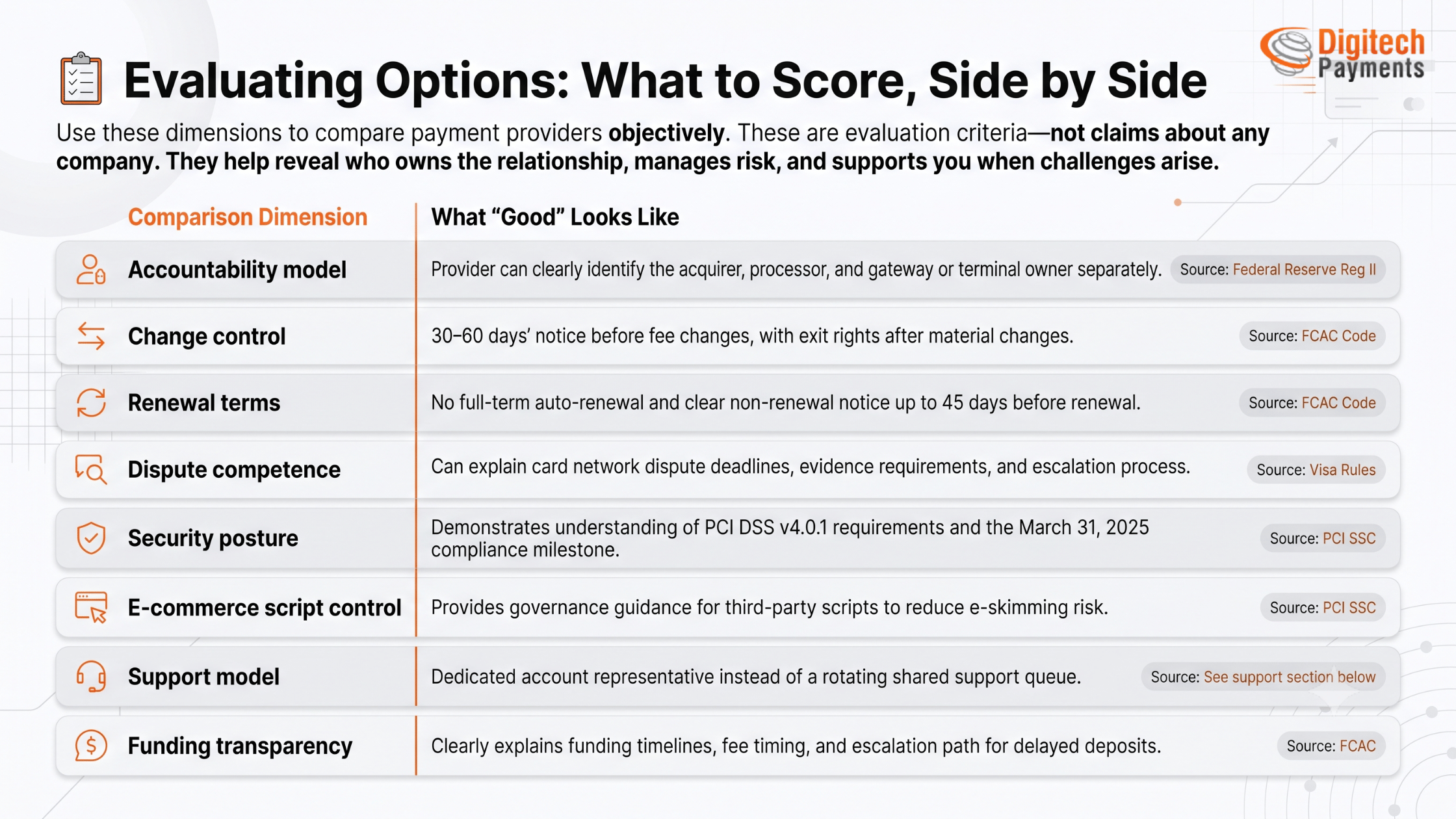
| Comparison dimension | What “good” looks like | Source anchor |
|---|---|---|
| Accountability model | Provider can name the acquirer, processor, and gateway/terminal owner separately | Federal Reserve Reg II |
| Change control | 30 to 60 days’ notice before fee changes; exit rights after changes | FCAC Code |
| Renewal terms | No full-term auto-renewal; non-renewal notice up to 45 days prior | FCAC Code |
| Dispute competence | Can explain network dispute time limits and required evidence | Visa rules |
| Security posture | Understands PCI DSS v4.0.1 and the March 31, 2025, effective date | PCI SSC |
| E-commerce script control | Helps govern third-party scripts to reduce e-skimming risk | PCI SSC |
| Support model | Dedicated point of contact vs. rotating pooled queue | See the support section below |
| Funding transparency | Clear escalation path for funding delays; fee timing explained | FCAC |
What does real white-glove human support look like?
Real human support means a consistent, named point of contact who reaches out before problems escalate, not a rotating call center you re-explain your business to every time. This is the difference between a partner and a vendor, and it shows up loudest during two moments: funding delays and disputes.
Here is why the support model is not a soft feature. The FCAC’s overview of card payments describes settlement as a multi-step flow through the processor, network, and issuers. When something in that chain stalls, you need someone who can tell you where the money is and push it forward. A pooled queue rarely can. A dedicated contact who already knows your account can.
At Digitech Payments, service is the whole story. We position ourselves as being present when it matters, during funding delays, disputes, and fraud, and on solving the problem in front of you rather than handing you a ticket number. That posture is easier to trust when a track record backs it. We got our start in 2011, giving us 15 years in the industry, and our reputation shows up in aggregated review signals: a Cylex Canada listing displays Digitech Payments at 4.4 of 5 across 1,019 reviews. We are a Registered MSP/ISO of the Canadian branch of U.S. Bank National Association and Elavon, which you can verify on our about page.
We lean on the Digitech track record because credibility should be checkable, not claimed.
When you compare a payment processor with human support, score these concretely: dedicated contact versus pooled queue, a named escalation path for funding delays and disputes, proactive outreach on policy changes and risk flags, and whether they coach you on what evidence to collect at the time of sale.
How Do Chargebacks Test a Provider’s Real Value?
Chargebacks are the moment your provider either shows up or vanishes, because disputes run on strict deadlines and specific evidence. This is where “partner, not vendor” stops being a slogan.
The numbers explain the stakes. The CFPB Consumer Credit Card Market Report reports that in 2024, the average value of a credit in response to a dispute was $197 on general purpose cards and $288 on private label cards, and that canceled recurring transactions drove 40% of all general purpose card disputes. On top of that, Mastercard’s analysis of chargeback costs forecasts global chargeback volume growing 24% from 2025 to 2028 to reach 324 million transactions annually. The volume is going up, so operational support during a dispute surge is only getting more valuable.
Deadlines are unforgiving. The public Visa Core Rules show that for the “Merchandise/Services Not Received” condition, a dispute must be processed no later than 120 calendar days from the transaction processing date, or 120 days from the last date the cardholder expected delivery, with certain time-limit concepts extending to a maximum of 540 calendar days in some contexts. A provider that can explain these windows and tell you exactly what documentation to gather for the dispute types you actually face is a provider doing its job. One that cannot leave you to fight alone.
Why Is PCI DSS a Trust Requirement, Not an IT Afterthought?
PCI DSS is a security standard your provider should actively help you meet, not a checkbox they leave entirely on your plate. The PCI Security Standards Council’s announcement confirms that PCI DSS v4.0.1 does not change the 31 March 2025 effective date for its future-dated new requirements. A trustworthy provider is already operating against that date and can tell you how they reduce your PCI scope.
For e-commerce merchants, the risk is sharper. The PCI SSC’s guidance on e-commerce requirements ties the future-dated e-commerce requirements to the rise of e-skimming attacks and the risk of third-party scripts running in your customers’ browsers. Ask any candidate how they help you govern those scripts. The answer tells you whether they think about your security as their responsibility or yours alone.
The 8-Step Due Diligence Checklist for Choosing Processor Partners
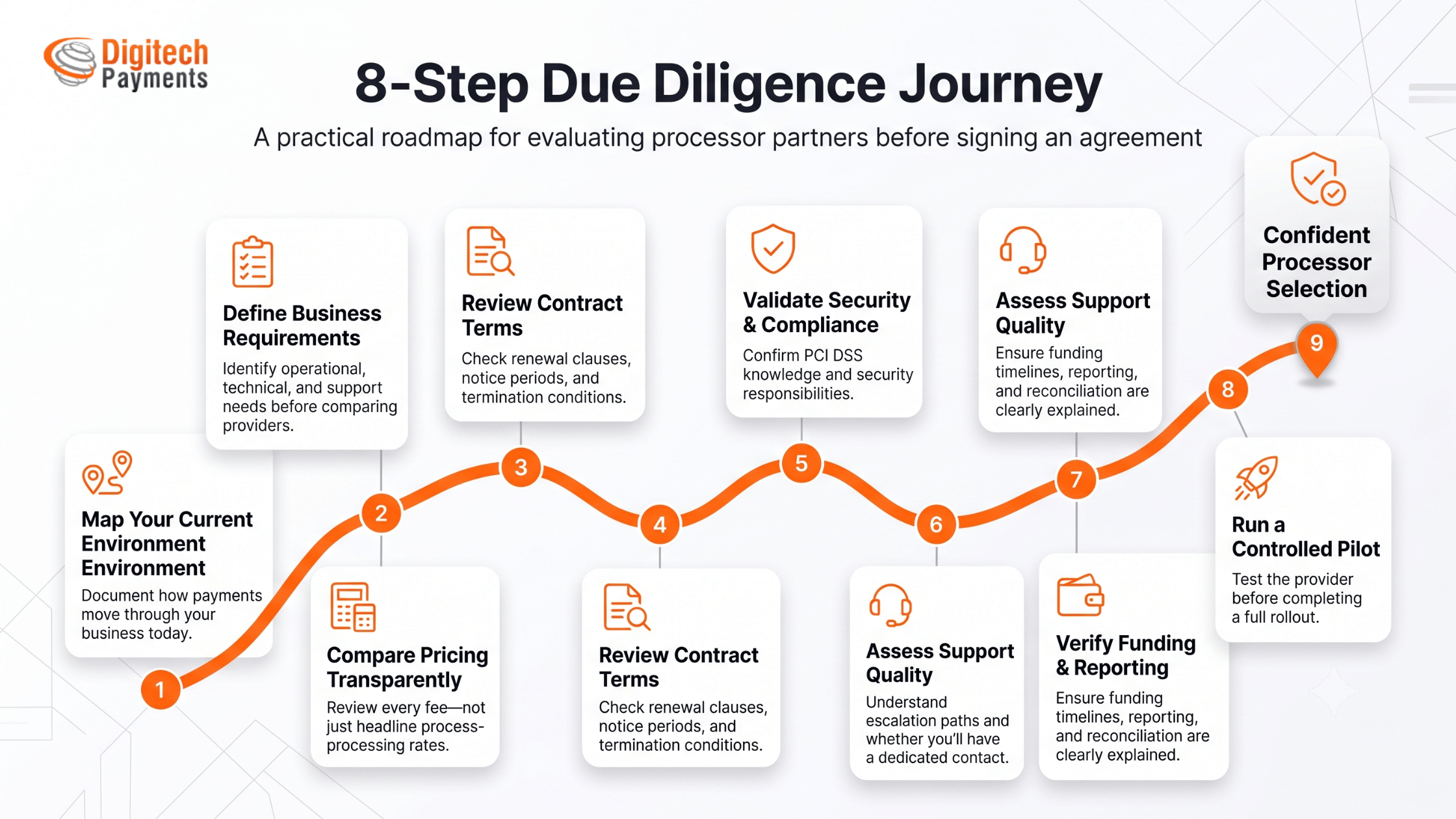
Run this process before you sign anything. It turns choosing processor decisions into evidence-gathering instead of guesswork.
- Map your acceptance reality. List card-present versus e-commerce volume, recurring billing, digital goods, your refund and returns model, delivery proofs, and where fraud can enter.
- Identify who’s accountable. Ask who the acquirer is, who the processor is, and who provides the gateway, terminal, or software. Use the formal Reg II definitions as your reference.
- Request full documentation before signing. Get the merchant agreement, any related equipment or software agreements, the cancellation procedure, renewal terms, the dispute process outline, and the complaint-handling path.
- Run a change-control audit on the contract. Find where fee changes are described, how notice is delivered, and what triggers cancellation rights. Benchmark against the FCAC Code of Conduct even if you are US-based.
- Validate dispute competence. Ask the provider to explain dispute time limits and the documentation required for the scenarios you face most, using the Visa rules as the yardstick.
- Validate security posture. Confirm how they reduce your PCI scope and their readiness for the PCI DSS v4.0.1 future-dated requirements.
- Support test before go-live. Call support, request an escalation, and ask specifically what happens during a funding delay and which channels handle urgent issues.
- Pilot and monitor. Run parallel reporting, reconciliation, and dispute workflows for an initial period. Confirm the settlement cadence and check that statements are clear.
If you want a sense of how a consistent point of contact and a proactive service workflow feel in practice, our about page is a fair place to start, and your broker can walk you through the rest against your own profile.
FAQs
Q1) What is the best merchant services provider for small businesses in Canada?
The best partner is the one whose accountability, contract terms, and support model you can verify against your own business, not the one with the loudest rate claim. Use Canada’s Code of Conduct as your benchmark for notice windows, exit rights, and renewal limits. Then, weigh reputation you can check, such as long operating history and aggregated reviews, alongside a support model that gives you a named contact rather than a queue.
Q2) How to compare merchant service providers beyond price?
To conduct a reliable merchant services comparison in Canada merchants can trust, start with the required Cost per Transaction Disclosure, which the FCAC says must appear in quotes and proposals so you can compare costs across providers apples to apples. Then score each provider on change-control terms, dispute competence, PCI support, and support model. Compare the whole relationship, not just a headline price, because the terms and the service determine your real cost over time.
Q3) Wondering how to compare merchant services providers without getting trapped later?
To evaluate these companies safely, focus your due diligence on the contract’s change-control and renewal language before you sign. Confirm the notice window before fee changes, your right to cancel without penalty after certain changes, and that fixed-term agreements do not auto-renew for a full term, all benchmarks drawn from the FCAC Code of Conduct. Ask for the cancellation procedure in writing up front, so exit terms are never a surprise.
Q4) Exploring how to choose a merchant services provider in Canada?
To make this decision, get each candidate to name the acquirer, processor, and gateway or terminal owner separately, since the Reg II definitions show these are distinct roles that determine who can fix what. Then test dispute competence, security posture, and support responsiveness with real questions before go-live. The provider that answers plainly and offers a consistent point of contact is usually the safer long-term partner.
5) What does white glove merchant support actually mean?
White glove support means a named person who knows your account, not a ticket queue. In practice, look for four things: one consistent point of contact you can reach directly; proactive notice when card network rules or risk requirements change; a defined escalation path when a deposit is delayed or a dispute is filed; and someone who works a chargeback surge with you rather than sending a help article. Before signing, ask who your contact will be and what happens when they are away. Digitech Payments has supported Canadian merchants from Montreal since 2011, in English and French.
Works Cited
- Consumer Financial Protection Bureau. “Consumer Credit Card Market Report.” December 2025.
- Cylex Canada. “Digitech Payments.”
- Digitech Payments. “About.”
- Federal Reserve. “Regulation II, Section 235.2 Definitions.”
- Financial Consumer Agency of Canada. “Code of Conduct for the Payment Card Industry in Canada.”
- Financial Consumer Agency of Canada. “Guideline on Disclosure of Sales and Business Practices under the Code of Conduct for the Payment Card Industry.”
- Financial Consumer Agency of Canada. “Overview of Card Payments for Merchants.”
- Financial Consumer Agency of Canada. “Rights of a Merchant.”
- Mastercard. “What’s the True Cost of a Chargeback in 2025?”
- PCI Security Standards Council. “Coffee with the Council Podcast: Guidance for PCI DSS E-commerce Requirements Effective After 31 March 2025.”
- PCI Security Standards Council. “Just Published: PCI DSS v4.0.1.”
- U.S. Government Accountability Office. “GAO-25-107298.”
- U.S. Treasury, Bureau of the Fiscal Service. “Card Acquiring Service: How CAS Works.”
- Visa. “Visa Core Rules and Visa Product and Service Rules.”
