
TL;DR: Key Takeaways on Credit Card Processing
- Authorization and settlement are separate services. Visa’s own acceptance documentation describes an authorization service and a distinct clearing-and-settlement service (Visa, 2018), which means an approved screen is not proof that funds have moved anywhere yet.
- The issuing bank makes the approval call, not your terminal. Mastercard describes authorization as the process of checking cardholder identity, card authenticity, and funds availability at the point of purchase before a response is received (Mastercard, n.d.).
- A pending charge is a normal, unavoidable stage. The Consumer Financial Protection Bureau defines pending debits as authorized but not yet settled and notes that they can reduce a customer’s available balance immediately (CFPB, 2022).
- Capture timing should match fulfillment. Visa’s developer documentation states that a capture should be submitted when the merchant fulfills the customer’s order (Visa, n.d.-e), which is especially important for shipped goods and services performed later.
- Data moves before money moves. Clearing exchanges transaction details between the acquirer and the issuer for posting and reconciliation; settlement is the separate, network-facilitated exchange of funds between those institutions.
Understanding Credit Card Payment Processing For Merchants In Canada And The United States
A card payment feels instant. The customer taps, the terminal beeps, the receipt prints, and everyone moves on. Behind that two-second experience, a chain of separate events is unfolding across several institutions, and understanding that chain changes how you run your business.
Transaction processing is the multi-stage sequence that carries a card payment from the customer’s tap or click through issuer approval, capture, clearing, and settlement, ending with funds moving between financial institutions before your merchant account is funded.
If you have ever asked yourself, “How do credit card payments work?” you are not alone. Knowing the answer is not academic trivia. It is what empowers you to:
- Answer customers confidently when they call about a pending charge.
- Decide accurately when to capture an online order.
- Recognize why an approval on the terminal is not the same as money in your account.
- Understand exactly when and how your credit card processing fees are applied.
We have spent 15 years at Digitech Payments helping merchants across Canada and the United States make sense of exactly this, and the questions we hear most often come down to one thing: nobody explained the middle of the process. This is that explanation, in plain English, with no jargon left undefined.
What Actually Happens When a Customer’s Card Is Charged?
When a customer’s card is charged, five things happen in sequence:
- The payment is initiated and transmitted.
- The issuing bank authorizes or declines it.
- The merchant captures the approved transaction.
- The transaction details clear between the banks.
- Funds settle between the issuer and the acquirer.
Only after all of that does your merchant account get funded, and that final step runs on your own merchant agreement, not on the network’s clock.
Start with the parties. A card payment involves five key entities:
- The customer: The cardholder initiating the payment.
- The merchant: Your business providing the goods or services.
- The merchant’s acquirer or processor: The financial institution that processes the payment on your behalf.
- The card network: The infrastructure (like Visa or Mastercard) connecting the merchant’s side to the customer’s side.
- The issuing bank: The financial institution that issued the customer’s card and holds their funds.
Mastercard’s switching services overview explains that a card network links the acquiring and issuing sides of a transaction and supports the core activities of authorization, clearing, and settlement (Mastercard, n.d.). That single sentence contains the whole architecture. The network is not a bank. It is the connective tissue that lets two banks that have never met transact reliably millions of times a day.
Authorization is the first real decision point. The same Mastercard documentation describes authorization as the process of moving requests, responses, cancellations, and related messages so that the payment system can verify cardholder identity, card authenticity, and funds availability at the point of purchase (Mastercard, n.d.).
Notice that the terminal is a messenger, not a judge. Visa’s 3-D Secure guide confirms that during authorization, the issuer checks details such as available funds, account status, and risk indicators, and then approves or declines the transaction (Visa, n.d.-c). If a good customer gets declined, your equipment is rarely the cause. The issuing bank made a risk call based on the information it had at that moment.
Where merchants get tripped up is what comes next. Visa’s payment acceptance guide describes the payment system as having an authorization service and a separate clearing-and-settlement service (Visa, 2018).
Approval and final financial completion are different functions handled at different times. That structural fact explains nearly every “where is our money” question we field, and it is the foundation for everything below.
How Does Credit Card Payment Processing Work From Tap to Terminal Response?
Credit card processing begins the moment a customer presents payment and, for the front-of-house portion, ends when your terminal or checkout page receives the issuer’s approval or decline response. In between, the payment data is protected in transit, routed through the acquiring side to the card network, and delivered to the issuing bank for a decision.
How the customer presents payment changes what happens in those first milliseconds:
- For an in-person chip transaction: EMVCo’s chip security overview explains that the merchant terminal can cryptographically authenticate the card and its data by verifying digital signatures generated by the card, the issuer, and the payment system (EMVCo, 2021). That is a meaningful difference from a magnetic stripe. The chip is not just storing a number; it is participating in the transaction. EMVCo’s cybersecurity reference guide notes that an EMV transaction generates a one-time-use security code derived from transaction-specific cryptographic data (EMVCo, 2025). It does not eliminate fraud, and no honest provider will tell you it does, but it means the data captured from one transaction is not simply reusable in the next.
- For a digital wallet payment: The number moving through your payment processing systems may not be the customer’s card number. EMVCo’s payment tokenization overview explains that EMV payment tokenization replaces the primary account number with a unique alternative value called an EMV Payment Token, which can be constrained to a specific merchant, device, or payment scenario (EMVCo, n.d.). Constrained is the operative word. A token pulled out of its approved context has limited usefulness.
- For card-not-present payments: These follow a different path entirely. Visa’s 3-D Secure documentation defines card-not-present transactions as those made online, in-app, or by phone, in which the physical card is never presented (Visa, n.d.-c). Because the card is absent, an extra step often runs first. Visa’s Visa Secure overview describes EMV 3-D Secure as enabling the exchange of transaction data between the merchant and the issuer before authorization to help validate that the payment is being initiated by the legitimate account holder (Visa, n.d.-d).
That is authentication, and it is not the same as authorization. Visa draws a clear line: authentication confirms who is making the payment, while authorization determines whether the payment can proceed (Visa, n.d.-c; Visa, n.d.-d). Passing authentication does not guarantee approval. The issuer still decides.
What Is the Difference Between Authorization and Settlement?
Understanding how credit card payments work means recognizing that the difference between authorization and settlement lies in timing and function. Authorization moves a decision, while settlement moves money.
To break this down:
- Authorization is the issuer’s real-time yes-or-no decision on a payment request.
- Settlement is the later, network-facilitated transfer of funds between the issuing and acquiring banks.
Between them sit two more stages that merchants often collapse together during daily credit card processing:
- Capture: This is your submission of an approved authorization for clearing and settlement.
- Clearing: Per Mastercard’s switching services documentation, this is the exchange of financial transaction details between the acquirer and the issuer to support account posting and reconciliation (Mastercard, n.d.). Think of clearing as ensuring that every institution holds a matching record of the same transaction.
Only after clearing does settlement occur. Mastercard describes this as the process in which the network facilitates the exchange of funds on behalf of issuers and acquirers (Mastercard, n.d.).
Visa’s payment acceptance guide draws the same distinction from the other direction. Clearing delivers transaction information for posting, while settlement reports and transfers the amounts owed between financial institutions (Visa, 2018). Data moves first. Money moves afterward. If you remember one sentence from this entire post, make it that one.
Here is why the distinction has operational teeth:
- An authorized transaction that is never captured does not clear or settle.
- A captured transaction with mismatched data can clear incorrectly.
- A settled transaction between two banks is still not the same event as your business getting paid, nor does it immediately reflect the deduction of your credit card processing fees.
Visa’s guidance is explicit that network settlement and merchant funding are related but separate (Visa, 2018). Your acquirer or merchant bank determines how funds are made available under your specific agreement. Any provider promising you a universal funding speed is describing their own arrangement, not a network rule.
This is also where merchants sometimes get burned by arrangements they did not fully read. Introductory terms that shift later, funding schedules nobody explained, support that disappears when a batch does not fund.
The fix is not a magic processor. It is about understanding which stage a problem lives in, so you can ask the right question of the right party. If you are unsure how your own funding arrangement is structured, that is a conversation to have directly with your broker, as it depends on your volume, transaction type, and channel mix.
Why Does a Customer See a Pending Charge After an Approval?
A customer sees a pending charge because the transaction has been authorized but has not yet settled. This gap is a normal part of transaction processing, not a mistake on your business’s part. The Consumer Financial Protection Bureau’s overdraft practices circular defines pending debits as authorized but not yet settled (CFPB, 2022).
The circular also makes two further points that are worth putting on a card next to your register:
- It affects balances instantly: A pending authorized debit can reduce a consumer’s available balance before it posts as a settled transaction. That is why a customer can tap to make a modest purchase and immediately see their available funds decrease, even though the transaction hasn’t finished processing.
- It is out of your control: The delay between authorization and settlement is part of payment-system processing. Your customer did not cause the pending charge, and neither did your staff.
There is a related wrinkle. The CFPB’s mobile banking tips note that the amount of a pending debit-card transaction may differ from the final amount that posts to the customer’s account (CFPB, 2020). That is legitimate in plenty of everyday scenarios, and it is worth training your team to explain rather than deflect.
Two authorization types explain most of those differences (Visa, 2024a):
- Estimated authorization: Used when the final transaction amount is not known at the start of the transaction. Hotels, vehicle rentals, fuel purchases, and open tabs all live here.
- Incremental authorization: Increases the total authorized amount when the previously authorized amount appears insufficient. An incremental authorization adds to the existing approval; it does not replace it.
Customers occasionally read those stacked entries as duplicate charges, which is exactly when a calm, informed explanation from your front-line staff can prevent an unnecessary dispute.
Visa’s reversal guidance also warns that missing or mismatched transaction data across estimated, incremental, reversal, and clearing messages can cause funds to be held longer than necessary or result in what customers interpret as an extra charge (Visa, 2024a). That is both a systems issue and a training issue. Both are fixable, and both are cheaper to fix than the goodwill they cost when ignored.
When Should a Merchant Capture an Approved Transaction?
A merchant should capture an approved transaction when the order is actually fulfilled.
Visa’s VisaNet Connect acceptance documentation establishes two key rules for an order fulfilled after checkout (Visa, n.d.-e):
- The purpose of the capture request. It is used to initiate clearing and settlement for a previously approved authorization.
- The timing of the capture. It should be exactly when the merchant fulfills the customer’s order.
For face-to-face businesses, this rarely creates friction. Visa’s documentation notes that a sale transaction is intended for purchases where goods or services are delivered immediately to the customer (Visa, 2018). A customer buys a coffee, takes it, and the transaction is recorded as a sale. Authorization and capture effectively collapse into a single moment because fulfillment occurs at the counter.
E-commerce is where capture timing becomes a genuine business decision. If a customer orders a custom item on Monday and it ships on Friday, the approved authorization remains in place for 4 days. Capturing at checkout means you have taken payment for something that has not yet been delivered. Waiting until shipment aligns the money with the merchandise, which is exactly what the guidance describes.
The same logic extends to scenarios that merchants in every vertical encounter. You should deliberately decide your capture policy for:
- Preorders: For items that do not exist yet.
- Partial shipments: Where half the order ships now and the rest ships next week.
- Bookings: Where the service happens weeks after the reservation.
- Custom fabrication: Where the timeline depends on materials.
A practical note for anyone reviewing this: the right capture behavior depends on your payment processing systems, your fulfillment model, and your card-on-file arrangements. Merchants running both a storefront and an online channel often need different settings for each, and these configurations live in your gateway or platform.
If nobody has walked you through those settings, it is reasonable to ask your provider to review them with you line by line. Contact our team to see how we handle this during onboarding, ensuring mismatched capture settings never generate unnecessary customer service calls.
The wrong approach is capturing everything immediately for cash-flow reasons while shipping on a long lead time. It increases refund volume, increases customer confusion about pending versus posted amounts, and gives disputes an easy foothold.
What Is the Difference Between a Void, a Reversal, and a Refund?
They solve different problems at different points in the lifecycle, and using the wrong one creates avoidable customer frustration. Here is how they break down:
- A Void. Cancels an outstanding or previously approved transaction before it completes. Visa’s VisaNet Connect documentation describes a void as the reversal of an outstanding or previously approved transaction, including in certain timeout situations (Visa, n.d.-e). A void is a pre-completion action, and its availability depends on your system’s capabilities and how much time has passed.
- An Authorization Reversal. Tells the issuer to release or adjust a hold on funds. Visa’s reversal processing guide defines this as a message that informs the issuer that all or part of a previously authorized transaction will not be completed (Visa, 2024a). This is the tool for the customer who authorized a large estimated amount and ended up spending far less, or for the order that gets canceled before it ships. Reversing an unused authorization releases the customer’s funds, rather than leaving them tied up while the hold ages out on its own.
- A Refund. Returns money after a purchase is completed. Visa describes a refund as a credit voucher or merchandise return submitted for a card- or token-based transaction (Visa, n.d.-e). If the money has already cleared and settled, a refund is your recourse. If it has not, a reversal or void is faster and cleaner for the customer.
Getting this wrong looks like this: A customer cancels an order, your team issues a refund on a transaction that was never captured, and now there is an unreleased hold and a credit floating in the system. The customer sees confusion on their statement and calls you.
Now, multiply that by a busy month, and you’ll have created a support burden out of a training gap.
Beyond these three sits the dispute process, which is not a merchant-initiated action at all. Visa’s dispute resolution overview describes a dispute as a reversal of all or part of a transaction’s value by the issuer to the acquirer, and usually by the merchant bank to the merchant (Visa, n.d.-b).
An approved, cleared, settled payment can still be disputed later. Approval was never a guarantee of finality, and building your operations on the assumption that it was is how merchants get caught flat-footed.
Can a Payment Still Become a Dispute After It Settles?
Yes. A payment that was authorized, captured, cleared, and settled can still become the subject of a dispute.
Visa’s dispute resolution documentation describes a dispute as a reversal of all or part of a transaction’s value by the issuer to the acquirer and usually by the merchant bank to the merchant (Visa, n.d.-b). That reversal happens after the fact, which is precisely why disputes surprise merchants who assumed that settlement closed the book on their transaction processing cycle.
The single most useful piece of guidance on this is also the simplest. When a merchant receives a dispute inquiry through its acquirer, Visa advises that a swift response is the best path toward resolution (Visa, 2024b).
Speed is the variable you control. The following items either exist in an organized form or they do not, and the moment an inquiry lands is not the moment to start building this file:
- The transaction record
- The fulfillment evidence
- The authentication data
- The delivery confirmation
- The customer communication history
Treat disputes as an operational workflow rather than a back-office surprise. That means setting up clear internal rules:
- Someone owns the inbox where inquiries arrive.
- Transaction records are retrievable by date, amount, and order reference without a scavenger hunt.
- Your staff knows what evidence a given transaction type generates and exactly where it lives.
On authentication and liability, a careful note matters more than an optimistic one. Visa’s dispute management guidelines state that Visa Secure can provide protection against certain fraud-related disputes for correctly processed, authenticated, or attempted-authentication transactions, but that liability-shift rules vary by region and transaction circumstances (Visa, 2024b).
Read that carefully. Certain disputes. Correctly processed. Varies by region. Nobody should tell you that adding 3-D Secure eliminates chargebacks, because the authoritative documentation does not say that. What it does say is that correct processing and accurate data submission put you in a better position than sloppy processing does.
This is the part of the payments relationship where service quality stops being a marketing term and becomes measurable. When a dispute inquiry arrives, or a batch does not fund on schedule, or a fraud pattern appears in your transaction data, you either have someone who answers and knows your account, or you have a ticket number.
We have built our reputation across more than 1,000 reviews and a 4.4 out of 5 rating largely on being present at those specific moments, and merchants tell us it is the difference they actually feel.
How Should Merchants Handle Payment Data Responsibly?
Merchants should handle payment data by collecting only what the business genuinely needs, never storing sensitive authentication data after authorization, and confirming their specific obligations with their acquirer and qualified assessor. Payment data security is not a one-time setup task; it is an ongoing governance responsibility shared across the entire credit card processing ecosystem.
The baseline framework is PCI DSS. The PCI Security Standards Council’s PCI DSS overview describes it as providing baseline technical and operational requirements to protect payment account data (PCI SSC, n.d.).
Crucially, the same source notes that PCI DSS applies to organizations (including merchants, processors, acquirers, issuers, and service providers) if they do any of the following (PCI SSC, n.d.):
- Store cardholder data.
- Process cardholder data.
- Transmit cardholder data.
- Affect the security of cardholder data.
You are not a bystander in that list. If cardholder data touches your payment processing systems or your people, you are in scope.
Two specific requirements are worth committing to memory because they resolve arguments quickly:
- Limit cardholder data retention: The Council’s FAQ states that organizations must limit retention to what is necessary for business, legal, or regulatory purposes and securely delete the data when it is no longer needed (PCI SSC, 2025). That rules out the common habit of keeping card details “just in case” a customer reorders.
- Prohibit storage of sensitive authentication data: The same FAQ prohibits storing this data after authorization, including full track data, card verification codes or values, and PIN block data (PCI SSC, 2025). If someone in your organization is writing security codes on an order form or saving them in a CRM note field, that practice needs to stop today.
Tokenization is a genuinely useful risk-reduction tool here, with an important caveat. Visa’s authentication identity guide indicates that tokenization can help reduce the risk of breaches and simplify PCI DSS compliance (Visa, n.d.-a). It supports compliance. It does not deliver it automatically, and no merchant should treat a tokenized stack as a finished compliance program.
The honest framing is this: nothing in this section is a legal or compliance certification, and it should not be read that way. Your actual obligations depend on how you accept payments, what systems you run, and what your acquirer requires. Confirm them with your acquirer, your payment provider, a qualified assessor, and, where appropriate, your legal advisers. What we can tell you from 15 years of merchant conversations is that the businesses with the fewest data problems are the ones that decided early to hold less data, not the ones that bought more tools.
Comparing Three Common Payment Flows
Not every card payment travels the same road. A chip card at your counter, a phone tapped at the same terminal, and an online checkout completed at midnight all end in the same issuer decision. However, the security mechanics leading up to that decision differ substantially.
When asking how credit card payments work across different channels, remember that understanding these differences is key to modern credit card processing. It helps you configure each channel correctly and helps your staff explain to customers why the experience varies.
The constant across all three is the issuer. Mastercard’s switching services documentation makes clear that authorization, clearing, and settlement remain part of the lifecycle regardless of whether a customer taps, inserts, enters credentials online, or uses a digital wallet (Mastercard, n.d.).
What changes are the evidence presented to the issuer before that decision, and the form the credential takes in transit? For merchants running both face-to-face and e-commerce channels, which describes a large share of businesses across Canada and the US, this table is a useful reference for channel-specific setup conversations.
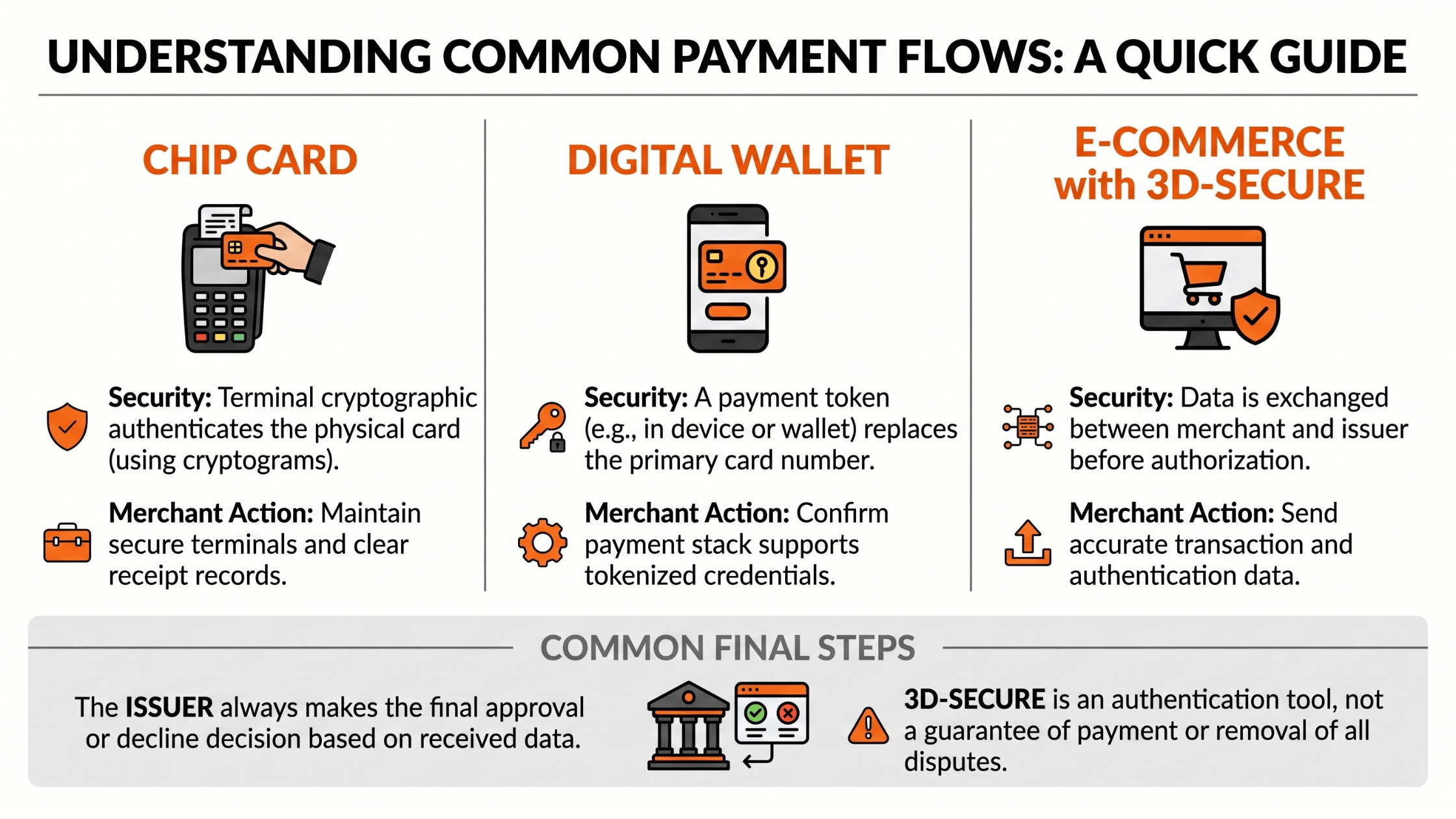
| Dimension | Chip card at the point of sale | Digital wallet payment | E-commerce with EMV 3-D Secure |
|---|---|---|---|
| How is payment presented | The customer inserts a chip card into a compatible terminal | Customer uses a tokenized credential from a device or wallet | Customer enters or selects credentials in an online checkout |
| Core security mechanism | The terminal can cryptographically authenticate the card and transaction data using transaction-specific cryptograms | The primary account number can be replaced by a payment token constrained to a merchant, device, or scenario | Authentication data can be exchanged between the merchant and the issuer before authorization |
| What the issuer still decides | Whether to approve or decline the authorization request | Whether to approve or decline the authorization request | Whether to approve or decline after any authentication stage |
| Merchant takeaway | Ensure the terminal and transaction flow support secure in-person acceptance and clear receipt records | Confirm your payment stack properly supports tokenized credentials and accurate transaction reporting | Send accurate transaction and authentication data; authentication does not guarantee approval or remove disputes |
The pattern is worth stating plainly: better front-end security changes the quality of the information reaching the issuer, but it never removes the issuer from the decision.
The Full Lifecycle Checklist: From Tap to Funding
Use this as an operational walkthrough of a single transaction. Every step below is drawn from network or regulator documentation, and each one is a place where merchant configuration or staff behavior can help or hurt.
- The customer initiates payment. They tap, insert, swipe where permitted, or enter details online. Your terminal, gateway, or checkout page begins assembling the payment request. Confirm that every acceptance point in your business is running current, supported software before you worry about anything downstream.
- Payment information is protected in transit. Your payment processing systems transmit the processing request. In a digital wallet or other tokenized flow, EMVCo’s tokenization documentation explains that a payment token may entirely replace the primary account number (EMVCo, n.d.).
- Online transactions may include authentication. For eligible e-commerce, EMV 3-D Secure exchanges data between the merchant and the issuer before authorization to help validate the cardholder (Visa, n.d.-d). Send accurate data here, because incomplete submissions weaken your position later.
- The authorization request travels through the ecosystem. The request moves through the acquiring side and the card network to the issuer. Mastercard’s documentation describes this routing as the network’s core function linking acquiring and issuing sides (Mastercard, n.d.).
- The issuer approves or declines. The issuing bank evaluates available funds or credit, account status, and risk information, then returns a response. Your terminal displays that decision; it does not make it. Train staff never to blame the customer for a decline.
- An approval may create a pending hold. If approved, the transaction can remain pending rather than settle, and the CFPB notes that the hold can immediately reduce the customer’s available balance or credit (CFPB, 2022). Prepare a plain-English explanation for anyone who asks.
- You complete or fulfill the order. For immediate delivery, the transaction proceeds as a sale. For goods shipped later or services performed later, hold the authorization and align the next step with actual fulfillment rather than with checkout.
- You capture the approved transaction. Capture initiates clearing and settlement for the previously approved authorization. Review your gateway’s default capture timing for each channel, and set it deliberately for each fulfillment model you run.
- Transaction details are clear. The acquirer and issuer exchange detailed financial transaction information required for account posting and reconciliation. Mismatched or missing data at this stage produces holds that linger and charges that customers misread.
- Financial institutions settle. The card network facilitates the exchange of funds between the issuer and the acquirer resulting from the cleared transaction. This is bank-to-bank movement, and it happens above your business rather than inside it.
- You receive funding under your merchant agreement. Visa’s acceptance guidance is clear that network settlement and merchant funding are separate, and that your acquirer or merchant bank determines how funds are made available (Visa, 2018). Read that section of your agreement, and if it is unclear, ask your broker to walk you through it.
- Post-transaction events may still occur. A canceled authorization may need a reversal. A returned purchase may need a refund. A posted transaction may become a dispute. Assign an owner to each of these before you need one.
- Reconcile and retain responsibly. Match your batch totals to deposits regularly, and keep only the cardholder data your business, legal, or regulatory obligations actually require. Sensitive authentication data must not be stored after authorization.
- Review your setup periodically. Channels change, fulfillment models change, and volume changes. A yearly review of terminals, gateway settings, capture behavior, and dispute workflow catches problems before customers do.
If your yearly review reveals that your current hardware or software is falling behind the curve, it might be time for an upgrade. Explore our reliable payment processing products to ensure every acceptance point in your business is running current, supported, and secure technology.
What Makes a Good Payment Processing Partner?
A good payment processing partner is one that teaches you how the system works, optimizes your transaction processing workflow, is reachable when something breaks, and structures pricing transparently around your actual business rather than an attractive opening number. Everything else is packaging.
Evaluate a potential partner using these four tests:
- Start with education. If your provider cannot explain the difference between authorization and settlement, or cannot tell you when your capture should fire for a shipped order, they are not equipped to help you when those mechanics cause a problem. The merchants who suffer the least from payment surprises are those whose providers explained the lifecycle before the surprise occurred.
- Presence is the second test. This is the one most merchants only discover under pressure. Funding delays, dispute inquiries, and fraud patterns do not arrive on a convenient schedule. Visa’s dispute guidance emphasizes that a swift response is the best path to resolution, a goal that is impossible if it takes days to reach a knowledgeable human (Visa, 2024b). White-glove service is not a courtesy in this industry. It is the operational difference between a resolved inquiry and an unnecessary loss.
- Look at how pricing is constructed. Look beyond a headline figure. The industry’s most common merchant complaint involves attractive introductory terms that increase over time and arrangements in which the merchant quietly assumes risks they never agreed to. Structured, transparent pricing negotiated around your volume, transaction types, business model, and channel mix behaves predictably. That is why we never publish rates. Your business is not the same as the business next door. For anything involving credit card processing fees, rates, or funding terms, talk to your broker for a customized quote based on your actual profile.
- Ask about due diligence. A partner who asks detailed questions about your model, average ticket size, refund patterns, and fulfillment timelines is building an arrangement that will hold up. One who does not ask is guessing, and guesses become problems at the worst moment.
We have been serving merchants since 2011 from Montreal, operating as a registered MSP/ISO of the Canadian branch of U.S. Bank National Association and Elavon. We support a diverse range of merchants across Canada and the United States in both face-to-face and e-commerce environments.
Fifteen years, more than 1,000 reviews, and a 4.4 out of 5 rating are not, by themselves, reasons to choose a provider, but they are a reasonable place to start your due diligence. Review our merchant solutions to see how this applies to your vertical.
The Bottom Line
Credit card processing is a complex, multi-stage sequence, not an instant transfer of funds. Understanding the differences among authorization, capture, clearing, and settlement enables you to make informed decisions about your credit card processing operations. The merchants who experience the fewest payment disruptions are those who actively manage their transaction lifecycle, secure their payment data, and recognize that an approval on a terminal does not equal money in the bank.
If you want a payment partner who actively helps you manage these mechanics and optimize your processing infrastructure, let us talk. We have spent 15 years helping merchants across the US and Canada reduce friction, configure the right capture settings, and keep more of their hard-earned revenue. Connect with us at Digitech Payments to see how we can build a secure, efficient payment setup tailored to your specific business model.
Frequently Asked Questions
1. What makes a good payment processing partner?
A good payment processing partner explains the mechanics of your payments before problems occur, responds quickly when disputes or funding questions arise, and prices transparently based on your specific volume and transaction types, ensuring you are never surprised by hidden credit card processing fees. Visa’s dispute guidance stresses that a swift response is the best path to resolution, but this only works if your provider is genuinely reachable (Visa, 2024b). Look for a partner that does real due diligence on your business model and fulfillment timelines. For any questions about rates or funding terms, talk to your broker for a quote built around your actual profile.
2. What happens when a customer’s card is charged?
When a customer’s card is charged, the payment request is transmitted to the issuing bank through your acquirer and the card network, and the issuer approves or declines based on available funds, account status, and risk indicators. If approved, the transaction may sit pending rather than settled, and the CFPB notes that a pending authorized debit can reduce the customer’s available balance immediately (CFPB, 2022). You then capture the approved transaction, details are cleared between the acquirer and issuer, and funds settle between those institutions before your merchant account is funded.
3. How does credit card payment processing work end-to-end?
Credit card payment processing works in five linked stages: initiation, authorization, capture, clearing, and settlement. Mastercard’s switching services documentation explains that the card network links the acquiring and issuing sides and supports authorization, clearing, and settlement as its core activities (Mastercard, n.d.). Authorization is the issuer’s real-time decision; capture submits the approved authorization for clearing and settlement; clearing exchanges the transaction details needed for posting and reconciliation; and settlement moves the funds between banks. Merchant funding then follows under your own merchant-account arrangement.
4. How does the card payment settlement process work after authorization?
After authorization, you capture the approved transaction, which Visa’s developer documentation says should happen when you fulfill the customer’s order (Visa, n.d.-e). Capture initiates clearing, where the acquirer and issuer exchange the detailed transaction information required for account posting and reconciliation. Settlement follows, with the card network facilitating the exchange of funds between the issuer and the acquirer. Your own funding is a separate step determined by your acquirer or merchant bank under your specific agreement, which is why no provider can promise a universal funding timeline.
5. What is the difference between authorization and settlement?
Authorization is the issuing bank’s real-time approve-or-decline decision on a payment request, based on available funds, account status, and risk indicators at that moment. Settlement is the later transfer of funds between the issuer and the acquirer, facilitated by the card network after the transaction has cleared. Visa’s payment acceptance documentation treats authorization, clearing, and settlement as separate services, which is exactly why an approved screen does not mean that money has moved (Visa, 2018). Data moves during clearing; money moves during settlement.
Works Cited
- Consumer Financial Protection Bureau (CFPB). Consumer Financial Protection Circular 2022-06: Unanticipated Overdraft Fee Assessment Practices. Consumer Financial Protection Bureau, 2022.
- Consumer Financial Protection Bureau (CFPB). Online and Mobile Banking Tips for Beginners. Consumer Financial Protection Bureau, 2020.
- EMVCo. EMVCo Cybersecurity Quick Reference Guide. EMVCo, 2025.
- EMVCo. EMV Chip Specifications to Support Elliptic Curve Cryptography. EMVCo, 2021.
- EMVCo. Payment Tokenisation. EMVCo, n.d.
- Mastercard. Transaction Switching: Our Technology. Mastercard, n.d.
- PCI Security Standards Council (PCI SSC). FAQ 1318: Cardholder Data Retention. PCI Security Standards Council, 2025.
- PCI Security Standards Council (PCI SSC). PCI DSS. PCI Security Standards Council, n.d.
- Visa. Authorization and Reversal Processing Best Practices for Merchants. Visa, 2024a.
- Visa. Merchant Dispute Management Guidelines. Visa, 2024b.
- Visa. Visa Payment Acceptance Best Practices for U.S. Retail Petroleum Merchants. Visa, 2018.
- Visa. Authentication and Identity. Visa, n.d.-a.
- Visa. Dispute Resolution. Visa, n.d.-b.
- Visa. 3-D Secure. Visa, n.d.-c.
- Visa. Visa Secure. Visa, n.d.-d.
- Visa. VisaNet Connect Acceptance. Visa, n.d.-e.
